

Lighthouse on a peninsula at night

TriangleSCI has concluded

The Triangle Scholarly Communication Institute began as an idea in 2013, and with support from our advisory board and partner organizations, and three successive grants from the Mellon Foundation, hosted an annual program from 2014 through 2024, with a 2 year hiatus at the height of the COVID pandemic.

As our funding was concluding at the end of 2024, we held a capstone program in October, reflecting on lessons learned, the values and models TriangleSCI promoted, the many projects launched here, and challenges and opportunities on the road ahead.

While the program has now concluded, you can find information about past programs and some of the projects launched here in the links below and throughout this site.

Thanks again to the Mellon Foundation for providing funding for this program, to Duke University Libraries for hosting it, to all of our partners and advisory board members for their contributions, and to all of the teams and participants for making it a wonderful experience each year.

Past year programs

[ Photo by William Bout used under Unsplash Free License. ]
Lighthouse on a peninsula at night

2024 Triangle Scholarly Communication Institute

Keen observers of this site might have noticed that we didn’t announce a request for proposals for TriangleSCI on the same schedule as in past years. That’s because this year’s program will be different than the previous Institutes – it’s the final year of the TriangleSCI program, so this year’s event will be more of a capstone symposium than the team-and-project based Institutes we’ve run for the past 8 years.

Yes, there have been 8 instances of TriangleSCI. The first one was in 2014 – 10 years ago! We skipped 2020 and 2021, at the height of pandemic, and resumed for 2022 and 2023. The Mellon Foundation generously provided the funding through this entire period, and the program has been hosted by Duke University Libraries in partnership with many other organizations in North Carolina’s Research Triangle region and beyond, as represented by members of our advisory board.

Over the previous 8 Institutes, dozens of teams and several hundred participants have come to the Triangle to work together on projects related to improving scholarly communication, and left here energized and ready to continue the work incubated. This year, as our funding concludes, we will gather participants from past years to reflect on their experience at TriangleSCI, lessons learned through projects launched or incubated here, and to consider how these lessons can be applied to scholarly communications reform more generally. Invited participants from past year Institutes will be panelists in a series of discussions on the first day, and on the second day we’ll reconvene with a set of breakout working groups, applying lessons learned at TriangleSCI to action plans that participants can use in their own contexts.

SCI 2024 will take place October 7 and 8, at Hunt Library on the Centennial Campus of North Carolina State University in Raleigh, NC.

As of this writing in April we’re preparing to invite past year participants to join us in the fall as panelists. Over the summer we’ll post more details about this year’s program, and open up registration for anyone who is interested in participating in October. While we can only cover costs for invited panelists, we hope many others will join this final edition of TriangleSCI to learn, contribute, and plan for the future of scholarly communication.

[ Photo by William Bout used under Unsplash Free License. ]

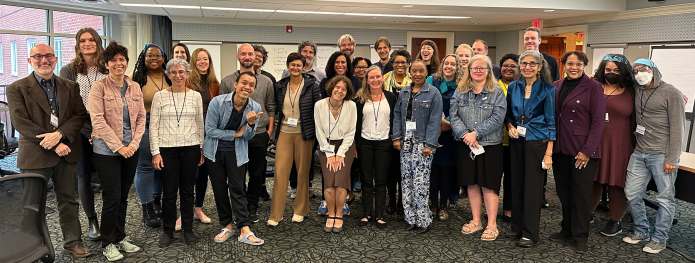
Group photo of SCI 2023 participants

SCI 2023 highlights

SCI 2023 started on October 8. Five teams were selected to participate based on a request for proposals in the spring, and arrived in North Carolina’s Research Triangle region to work on projects based on this year’s theme of Trust. You can learn more about the teams and their projects here:

This post will feature some highlights from each day, and outcomes will be linked from the SCI 2023 page after this year’s program concludes. You can also follow our Twitter feed and the #TriangleSCI hashtag for more updates, and engage us in conversation there.