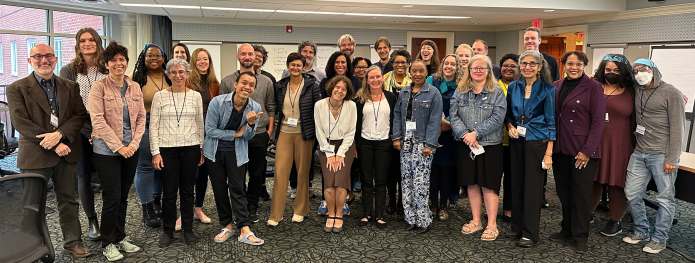

Join us for the final year of TriangleSCI on October 7 and 8 to participate in discussions about key issues in scholarly communication and develop plans for how you can activate what you learn in your own work.
You’re invited to participate in the 2024 Triangle Scholarly Communication Institute, held October 7 and 8, 2024, at Hunt Library on the Centennial Campus of North Carolina State University in Raleigh, part of the Research Triangle region of North Carolina.
Over the previous eight Institutes, dozens of teams and several hundred participants have come to the Triangle to work together on projects related to improving scholarly communication, and left here energized and ready to continue the work started at TriangleSCI.
This year, as the funding for this program concludes, we will gather in a capstone symposium, to reflect on important issues and lessons learned through projects launched or incubated at TriangleSCI, explore emerging challenges and opportunities in scholarly communication, and make plans for next steps.
The full schedule and further information are below. Registration closed on September 20, but if you’re interested in participating, please email info@trianglesci.org and we may still be able to get you in. Participation is free, and parking, snacks, and a box lunch will be provided. We encourage faculty, students, researchers, librarians, people working in publishing, research funding, other areas of academia, or anyone interested in the work of scholarly communication to join us for this stimulating and interactive program.
2024 TriangleSCI Schedule
Duke Energy Hall, James B. Hunt Jr. Library
Centennial Campus, North Carolina State University
Raleigh, North Carolina
Monday, October 7, 2024 |
|
8:30am – 9:00am |
Registration, coffee and light breakfast, meet your colleagues |
9:00am – 9:45am |
Opening remarks and overview of TriangleSCI’s history and this year’s programPaolo Mangiafico – Director, Triangle Scholarly Communication Institute |
9:45am – 10:45am |
Panel Discussion 1The Case for Values in Scholarly CommunicationThis session will use publishing as a prism to reconsider how campus-led values should and can drive change in scholarly communication. The panel will describe examples of new paradigms, infrastructure, and business models that originated at Triangle SCI and have gone on to make significant impact. Moderator: Tom Scheinfeldt – Professor of Digital Humanities, University of Connecticut Panelists:
|
10:45am – 11:00am
|
Break |
11:00am – 12:00pm |
Panel Discussion 2Taking action to address inequities in scholarly communications and academiaThis session will feature a discussion of historical and structural inequities, how they affect the people and processes of scholarly communication and academic research, and what we can do to combat the inequity and promote a more fair and just scholarly communication ecosystem. Moderator: Courtney Berger – Executive Editor, Duke University Press Panelists:
|
12:00pm – 1:30pm |
Box lunch, and optional tour of Hunt Library
|
1:30pm – 2:30pm |
Panel Discussion 3Removing barriers and promoting broader access, accessibility, and engagement in scholarly communications and academiaThis session will feature a discussion looking at different ways of engaging with people who have largely been excluded from the dominant scholarly communication venues. What tools, techniques, and policies could scholars, publishers, and institutions use to better engage and build trust with broader sets of stakeholders? Moderator: Kuldip Kuwahara – Professor, Language and Literature, Panelists:
|
2:30pm – 3:30pm |
Panel Discussion 4Emerging Challenges and OpportunitiesThis panel will feature a discussion of emerging challenges and opportunities for scholarly communication and academia more broadly. How do we foresee trends in artificial intelligence and “surveillance capitalism” playing out in research and publishing? What ethical, legal, financial, or other impacts might be on the horizon related to emerging technologies, political pressures and regulatory changes, demographic shifts, climate change, or other broad societal changes? What are some things we could do to effect and incentivize positive outcomes, and avoid negative ones? Moderator: Dave Hansen – Executive Director, Authors Alliance Panelists:
|
3:30pm – 3:45pm |
Break
|
3:45pm – 4:30pm
|
Round-table discussionLessons learned from eight years of TriangleSCI, and how to carry it forwardThis round-table discussion will include anyone who has participated in TriangleSCI in the past. We’ll discuss how TriangleSCI was structured, what worked well, what could have been better, what we changed and improved, and what we learned from it that might be applicable to similar programs elsewhere. Team participants will be asked to reflect on how they went from an idea to a team to a project, and what helped or hindered the project’s longevity and success. Moderator: Liz Milewicz – Director, The ScholarWorks Center for Open Scholarship, Duke University Libraries |
4:30pm – 5:00pm |
Wrap-up and planning for the next day
|
Tuesday, October 8, 2024 |
|
8:30am – 9:00am
|
Announcements and organizing for the day, with coffee and light breakfast
|
9:00am – 10:00am |
First breakout group sessionWe’ll break into working groups based on topics from Monday’s panels, to develop action plans that participants can take back to their home contexts to launch or support projects based around topics covered in that panel or scholarly communications issues more broadly. Groups will be given a rubric with some information to document, that can serve as the basis for action plans for future work. |
10:00am – 10:30am |
BreakDuring the break, participants can walk around to other groups to learn about their draft plans, offer comments, discuss, and think about how anything they learn could be applied to their group’s work. |
10:30am – 11:00am
|
Second breakout group sessionReconvene with people from the first breakout group session to finalize plans for how to report out/tell others about your action plan and lessons learned. |
11:00am – 12:00pm |
Reporting out and discussionEach breakout group will have a few minutes to report out on their discussions and plans, with some time for Q&A. |
12:00pm – 12:30pm |
Concluding remarks and next steps after TriangleSCIPaolo Mangiafico – Director, Triangle Scholarly Communication Institute |
Registration and participation information
- Registration closed on September 20, but if you’re interested in participating, please email info@trianglesci.org and we may still be able to get you in.
- You are welcome to participate for both days, or just the first day
- Registered participants will receive an email about a week before the event with information on how to get a free parking pass for a parking deck near the Hunt Library on NCSU Centennial Campus
- Drinks, snacks, and a box lunch will be provided to registered participants
More information about TriangleSCI
To learn more about previous years of the Triangle Scholarly Communication Institute and the kinds of themes covered and projects that were developed, see the links below. More information about TriangleSCI can also be found in our FAQ.
- SCI 2014 web site
- SCI 2015 web site
- SCI 2016 web site
- SCI 2017 web site
- SCI 2018 web site
- SCI 2019 web site
- SCI 2022 web site
- SCI 2023 web site
If you have questions about the Institute, please e-mail scholcomm-institute@duke.edu
[ Photo by William Bout used under Unsplash Free License. ]