Using Storytelling to Share Research in a Time of Mistrust

This is the second in a series of posts about each of the teams that will be attending SCI 2017, and their projects. This one was submitted by Franny Gaede.

For the 2017 Triangle Scholarly Communication Institute, our group will look at how storytelling techniques, specifically those used in journalism and folklore studies, can be used to help combat anti-intellectualism faced by scholars and reporters. This idea came from discussion about current information culture (i.e.: “alternative facts” and “fake news”), how scholarly research has been mis- or underrepresented in news media, and how “bad science” and retractions have promoted public distrust of scholarship.

Man reading a newspaper in a doorway

Institutions of higher education are often characterized as bastions of liberalism, which in a politically charged environment will hinder academics’ ability to communicate effectively with the public. This perceived politicization affects the research output of colleges and universities and the ability of the news media to cover research-based stories as they compete for the attention and confidence of their audience. Democratization of information has exacerbated this to some extent. The reduction or elimination of gatekeepers has enabled scholars to engage in disseminating their research but has also contributed to the spread of misinformation and made evaluating information far more difficult.

Scholars have also expressed concerns about sharing their work widely for fear that it will be misinterpreted (see The Heartland Institute’s 500 Scientists with Documented Doubts of Man-Made Global Warming Scares, featuring a number of scientists who later came out protesting their inclusion on the list suggesting their research had been misinterpreted)1, 2 or targeted for grant revocation (see HR 5155, proposed legislation prohibiting the NEH from funding the Popular Romance Project and similar projects.) Still other scholars show a lack of interest in sharing their work with the public as  they report believing the people who need access to their work – other researchers – already do; this, in turn, can help reinforce the idea among the general public that these researchers are elitists locked in their ivory tower.

We intend to approach this problem from the perspectives of educators, folklorists, journalists, librarians, and researchers. Our proposed solutions will involve the use of personal narratives to help make real people the face of the issue at hand and help add empathy to discussions about research and scholarly output. We’ll focus on supporting researchers, librarians, and other involved parties who use or want to use popular/populist platforms like blogs, Twitter, Instagram, and podcasts and offer primers on different methods for evaluating impact.

Our goal with this approach is, as stated in the Call for Proposals, “build bridges with constituencies that normally don’t feel connected to universities, and who may even feel antipathy to them.” We would like to engage these constituencies using storytelling techniques borrowed from journalism and folklore and ideas gleaned from popular “edutainment” and popular science entities, including I Fucking Love Science, lol my thesis, TED Talks, and the VlogBrothers’ Crash Course series. We also want to look at entities engaged in repackaging complex topics, such as eLife Digests, Vox, News in Slow, and Thing Explainer to consider how plain-speaking in scholarship can encourage engagement.

The team includes scholars engaged in research on fairy tales, digital humanities, social justice, sex education, experiential learning, digital storytelling, scholarly communication, and diversity in news, among other research interests. We hold positions ranging from tenure-track faculty to blogger to full-time librarian to alt-ac scholar, having worked in newsrooms, classrooms, and libraries. Between our collective interests and our collective experience, we have the necessary perspective to productively engage in our proposed topic at TriangleSCI and successfully produce the toolkit outlined below.
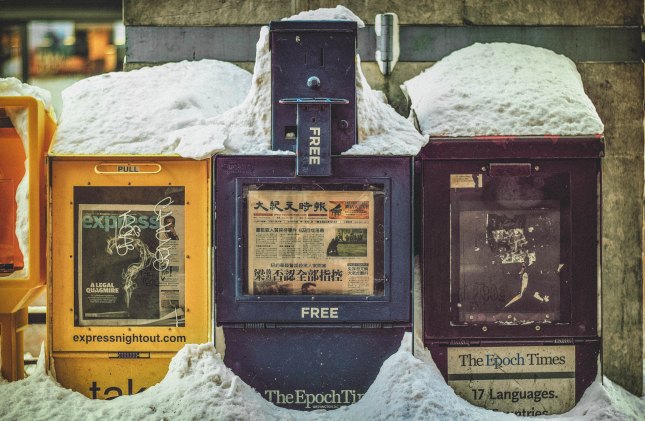
Newspaper stand in the snow

Team Members

Franny Gaede. Scholarly Communication Librarian at Butler University, liaison librarian for the Department of Modern Languages, the Department of Philosophy, Religion, and Classics, Honors, Global and Historical Studies, and First Year Seminar. My particular research interest is social justice and open access and I work mostly with faculty and undergrads. I feel strongly that accessibility to research ought to include accommodations, access, and readability. You should not need a PhD in a subject to be able to read about it! In addition to my deep interest in scholarly communication, I am an amateur designer with many feelings about fonts, a keen observer of the tech industry, and a five-time participant in National Novel Writing Month.

Jeana Jorgensen. Alt-ac scholar (currently a lecturer at UC Berkeley; home base is adjuncting at Butler University). I research gender and sexuality in fairy tales, narrative folklore more generally, digital humanities, dance, body art, queer and feminist theory, and the history and cultural reception of sex education. My college courses span folklore, anthropology, and gender studies, focusing on teaching students to identify the intersections of cultural context, narrative, and identities. I also blog at Patheos.com and Conditionally Accepted, and have guest blogged widely, contributing to my mission of scholarly outreach.

Ashley Rosener. Grand Valley State University liaison librarian for the School of Social Work, the School of Public, Nonprofit, and Health Administration, and the Johnson Center for Philanthropy. I work with both undergraduate and graduate students and regularly provide instruction, both in the classroom setting and through workshops for students and faculty/staff. I work with students and faculty one-on-one, helping them find reliable sources for their assignments and research. I also maintain the library collections (books, journals, films, databases, etc.) for my liaison areas. I bring to this group my expertise as a liaison librarian alongside a passion for and engagement in scholarly communications issues.

Teresa Schultz. Teresa Auch Schultz is the scholarly communications and copyright librarian at the University of Nevada, Reno, where she advocates for open access of scholarly articles and other work among the UNR community. Previously, Teresa worked as a reporter for local newspapers in Indiana for 10 years. Teresa is interested in new forms of scholarly communication, such as open access, and how research can be made accessible to everyone, not just academia in the Western Anglo world. Her background as both a scholarly communications librarian and journalist will help contribute a knowledge of how researchers work and what motivates them and how that fits with traditional storytelling methods used by journalists to communicate to the public.

Jessica Sparks. Jessica Sparks is a former political reporter from Indiana who transplanted to the South. With a bachelor’s in journalism and a master’s in digital storytelling, she has served in several roles for news organizations. In 2013, Sparks was part of the first cohort of the International Center for Journalists “Back to the Newsroom” fellowship, where she worked for the Wall Street Journal. Her research areas include journalism, gender issues, diversity in news and newsrooms, and social media. At Savannah State University, Sparks teaches undergraduate mass communications courses focusing on writing, news reporting, research methods, and basic design principles.

Amanda Starkel. Information Commons and eLearning Librarian, Butler University. As Information Commons and eLearning Librarian, I manage the students and staff who run our service point in the library. Our program is focused on experiential learning and includes assessed student learning objectives and peer teaching.  I also maintain traditional liaison responsibilities such as instruction, assessment, collection management, and outreach. Before Butler, I served as Interim Director and Instruction Librarian at Defiance College. My expertise is in user services and information literacy instruction, but I excel at thinking creatively to solve problems and offer broad academic experience to this group.

Output

Our intended output is a toolkit that will include the following items:

  • Breakdown of different storytelling genres, including classical folklore genres and pop culture examples to help users harness generic associations and aid them in making certain points or reaching specific demographics
  • Advice for researchers on building pre-made video news releases, interactive infographics, and podcasts, including guidance on using humor, emotion, and personal narratives to encourage understanding, empathy, and sharing (i.e.: how to go viral)
  • Unbranded, editable Creative Commons-licensed templates to be used on social media to share research

[ Photos by Thong Vo and Matt Popovich used under Unsplash free license.]
Digital Storytelling and the Future(s) of Multimedia Scholarship

This is the first in a series of posts about each of the teams that will be attending SCI 2017, and their projects. This one was submitted by Hannah McGregor.

Introduction:

In this era of pervasive digitization, political polarization, and media saturation, the academy needs to foster—and value—narrative practices that contribute to genuine public engagement with questions of what it means to be part of a public. The problems facing democratic society right now are not technological problems, but rather narrative chasms amplified by technological platforms and digital communications systems. Symptomatic of this development are the profound gaps between those trained to think critically about culture, art, or philosophy—those within les sciences humaine (the human sciences) who investigate what it is to be human, alone and together—and the general public (whatever that means). We are all increasingly bombarded with stories told by vested interests, in exchange for money, data, clicks, and eyeballs. But these platforms and channels are focused on cultivating attention and generating money rather than a functional democracy, social justice, or even the old standard of the philosophically ‘good’ life.

Effectively telling the stories of our research and of our teaching is crucial to a functional society. We have no illusions as to how the traditional work of the arts & humanities is viewed by the public, a perception that such work is at best unnecessary and at worst malicious. Recent calls to eliminate via non-funding the National Endowment for the Arts and the National Endowment for the Humanities in the United States of America only underscore the urgency of this discussion, and how far from a social consensus on such work we have found ourselves through systemic inattention, perverse incentives, and cultural/institutional inertia.

This working group, while we cannot solve these problems in their entirety, believes that changing these entrenched narratives is not only possible, but can be undertaken constructively with joy, with empathy, and with excitement.

Guiding Questions:

  • How can scholar-teachers integrate existing digital media platforms and activities into current practice for more effective research, teaching, and community building? (“What would an academic podcasting or a podcasting network even look like?”)
  • What frameworks are in place for assessing and rewarding these practices within colleges and universities, scholarly societies, and funding agencies? (“Can I submit five years of internet radio broadcasting to my tenure committee? Should I?”)
  • In what way do our choices of what to build and deploy in research and teaching change those practices? (“What does constructive, pedagogical interaction in a multiplayer first person shooter video game even mean? Can e-lit prompt us to rethink our subjectivity in a way that printed works cannot?”)
  • How can we begin working with these vectors of activity to build better societies, from our classrooms to our regions to our world? (“Is what we are doing online actually impacting what we do in our communities? How do we ascertain if it is? How can podcasting, digital gaming, and internet broadcasting come together for social change?”)

Objectives:

Our overarching objective is to begin a conversation amongst ourselves but also, crucially within the wider SCI community, on how multimedia digital objects, storytelling and narrative, and building better societies intersect. Bringing a working group as diverse as this one together—compounded by the varied viewpoints we are sure the SCI will bring together as a cohort—we hope to use this as an opportunity to begin a conversation.

  1. PodcastingSCI: Several of our group have longstanding interests in sound design and public outreach using recording & broadcasting technology. PodcastingSCI will be, in essence, a ‘live’ record of activities at SCI and the always impressive group that will gather in North Carolina. We are partly inspired by the approach of the #dariahteach group in Europe which has, in order to give fuller discussion to digital humanities pedagogy, produced a series of video interviews with experts in the field:
  2. Public-Facing Multimedia Casebook: Those wishing to integrate public-facing digital multimedia content into their everyday intellectual practice often face difficulty finding examples or successful models. Our group plans to compile a casebook documenting how these moments have played out in our own teaching & research. Containing at least sections addressing our own working group (electronic literature, games, broadcasting, podcasting, social media outreach), this will be an extensible output; contributions from other SCI attendees will be actively sought, onsite or after the event, and it has the strong possibility to extend even further. Documenting practice in emerging areas is vital to ensuring their propagation, and the Antigonish2 group (http://antigonish2.com/) has committed to hosting this resource; the “evolving anthology” model used by the Modern Language Association with their volume Digital Literary Studies (https://dlsanthology.mla.hcommons.org/) is another possible publication model.
  3. Best Practices and Guidelines: In the course of our work, we anticipate that a discussion of best practices and guidelines for doing this kind of intellectual outreach well will naturally emerge. Drawing on both the input of other SCI attendees (gained through podcast interviews) and real-world case studies (drawn together in our casebook collection), this document is intended for scholar-teachers interested in public-facing, digital multimedia scholarship in a variety of institutions.
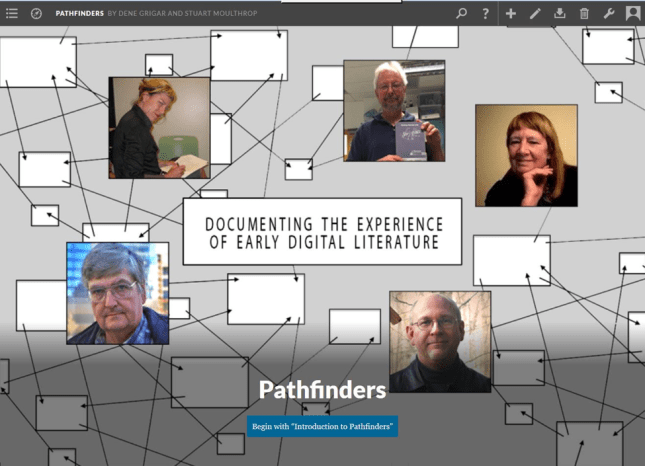
Screen shot from Dene Grigar and Stuart Moulthrop’s Pathfinders multimedia Scalar book

Dene Grigar and Stuart Moulthrop’s Pathfinders multimedia Scalar book was recently recognized in The Academic Book of the Future project produced by Marilyn Deegan for the Arts and Humanities Research Council (UK) and the British Library.

Our Team:

Our international and interdisciplinary working group consists of six teacher-scholars with distinct expertise in scholarly storytelling, including games, electronic literature, digital radio, podcasting, and social media. We also share a collective investment in student-centred and practice-based teaching, and a concern with how innovative pedagogy can help to break down the walls between the university and the public. We are largely based in Canadian higher education, and nearly all group members work in regional, student-centred universities rather than R1 institutions. Some have held administrative roles in large research projects and led or taken part in international academic organisations. Some are early-career scholars based in professional disciplines, while others bring to this group extensive experience in education practice and policy—with the reality, of course, that all group members bring some combination of many of these profiles. This working group represents a new collaborative enterprise for all of us, one that pushes us to reframe our scholarship in the light of larger conversations about digital storytelling and multimedia scholarship.

  • Alyssa Arbuckle (http://www.alyssaarbuckle.com) is Assistant Director, Research Partnerships & Development, in the Electronic Textual Cultures Lab (ETCL) at the University of Victoria. In this role she works with the Implementing New Knowledge Environments (INKE) group and assists with the coordination of the Digital Humanities Summer Institute (DHSI). Arbuckle is also an interdisciplinary PhD student at the University of Victoria, studying open social scholarship and its implementation (planned completion 2019). Her previous studies at the University of British Columbia and University of Victoria have centred around digital humanities, new media, and contemporary American literature. Currently, she focuses on open access, digital publishing, and how text lives online, which will directly influence her engagement with this working group.
  • John F. Barber (http://www.nouspace.net/john/) currently teaches in The Creative Media & Digital Culture program at Washington State University Vancouver. His scholarship, teaching, and creative endeavors focus on digital archiving / curation and sound+radio art. John developed and continues to curate the Brautigan Bibliography and Archive (brautigan.net), an online, interactive information structure known as the preeminent resource on the life and writings of American author Richard Brautigan. He also runs Radio Nouspace, which is both a repository and a laboratory supporting his research, scholarship, teaching, and creative practices regarding radio, sound, and listening as closely connected with communication, creative endeavor, literacy, and social justice. As a repository, Radio Nouspace collects and organizes information and resources. John brings to our working group a historically-grounded understanding of radio and digital broadcasting, as well as the ways those technologies can structure communities of interest around particular figures, issues, and topics.
  • Dene Grigar (http://www.nouspace.net/dene/) is Professor and Director of The Creative Media & Digital Culture Program at Washington State University Vancouver whose research focuses on the creation, curation, preservation, and criticism of Electronic Literature, specifically building multimedial environments and experiences for live performance, installations, and curated spaces; desktop computers; and mobile media devices. She has authored 14 media works such as “Curlew” (2014), “A Villager’s Tale” (2011), the “24-Hour Micro E-Lit Project” (2009), “When Ghosts Will Die” (2008), and “Fallow Field: A Story in Two Parts” (2005), as well as 52 scholarly articles. She also curates exhibits of electronic literature and media art, mounting shows at the Library of Congress and for the Symposium on Electronic Art (ISEA) and the Modern Language Association (MLA), among other venues. As Director of an academic program in a seemingly always new field, Grigar has had to find ways to credential faculty, demonstrate scholarly viability of collaborative research, and develop assessment documents that evaluate excellence. She brings 25 years of teaching experience in higher education to our working group.
  • Hannah McGregor (https://hannahmcgregor.com/) is an Assistant Professor in the Publishing program at Simon Fraser University in Vancouver, where her research and teaching focuses on the histories and futures of print culture and new media in Canada, with a focus on Canadian middlebrow magazines, and podcasting as both self-publishing and public pedagogy. Hannah is also involved in research projects on scholarly podcasting and on inclusivity and accountability in Canada publishing. For this working group, her interests in the intersection of feminism and new media, particularly the challenges facing women in digital spaces, is most relevant. With collaborator Marcelle Kosman, she makes Witch, Please (http://ohwitchplease.ca/), a feminist podcast about the Harry Potter world. They have spoken about their public pedagogy and fandom in a variety of venues, including the feminist journal Ravishly, CBC Edmonton AM, the Edmonton Journal, and at various fan and entertainment expos around Canada.
  • Jon Saklofske (http://socrates.acadiau.ca/courses/engl/saklofske/about.html) is a Professor at Acadia University in Nova Scotia, Canada. His specialization in the writing of the British Romantic period and continuing interest in the ways that William Blake’s composite art illuminates the relationship between words and images on the printed page has inspired current research into alternative platforms for open social scholarship as well as larger correlations between media forms and cultural perceptions.  Jon is a longstanding member of the Implementing New Knowledge Environments (INKE) project, and is exploring ways to incorporate virtual environments and game-based stories into research and teaching.  Other research interests include environmental storytelling in Disney theme parks, the critical potential of feminist war games, and representations of agency and self in video games.
  • Bonnie Stewart (http://bonstewart.com/) is an educator and social media researcher fascinated by who we are when we’re online. Coordinator of Adult Teaching programs at the University of Prince Edward Island, Canada, and Founder/Director of the media literacy initiative Antigonish 2.0, Bonnie explores the intersections of knowledge, technology, and identity in her work. Community capacity-building and professional learning are the focus of her current research, which considers the tensions of networked and institutional practices in higher education. Bonnie writes and speaks about networked scholarship, digital strategy, leadership, and massive open online courses (MOOCs) around the world, and her work aims to enact the open, participatory, and collaborative ethos that it examines. She blogs ideas at http://theory.cribchronicles.com, and does her best thinking out loud on Twitter as @bonstewart.
Colored pencils

SCI 2017 project teams

Thanks again to everybody who submitted proposals to participate in the 2017 Scholarly Communication Institute! This year’s theme stimulated some wonderful ideas and many excellent proposals, and it was very difficult for the SCI advisory board to narrow down the pool to the small number of teams we are able invite to participate in November.

All of the invited teams have now confirmed their participation, so we’re pleased to announce who they are and the titles of their projects. Each title links to further information about the project and participants:

Congratulations to all of these teams, and we look forward to seeing you in Chapel Hill in November!

[ Edited on 6 September to reflect changed membership of several teams, and to link to project details. ]

[ Photo by PICSELI used under Unsplash free use license. ]