Bringing Equity and Diversity to Peer Review

This is the fourth in a series of posts about each of the teams that will be attending SCI 2019, and their projects. This one was submitted by Daniela Saderi.

Illustration of peer review

The current system of scientific peer review is flawed. Research is evaluated by a handful of unpaid reviewers selected by journal editors as “experts” in the field. Two or sometimes three reviewers are chosen opaquely, often through personal connections. Behind closed doors, they decide the fate of a research article, largely basing their evaluation on subjective criteria. Paradoxically, while peer review is a key component for scientific dissemination, very few scientists receive any formal training in it.

This arcane process is not only slow and inefficient – with waiting periods from submission to publication of six months or more – but also disadvantages researchers from under-represented groups or under-resourced institutions. When they submit their research for peer review, their work is evaluated using standards developed for research groups with vastly more resources and connections. The gatekeepers of scholarly publication are disproportionately male (Helmer et al. 2017; Lerback, American Geophysical Union, and Brooks Hanson 2016; “Nature’s Sexism” 2012; Fox, Sean Burns, and Meyer 2016) and from North America or European countries (Chawla 2018; Murray et al. 2018). Rarely is research evaluated by a diverse pool of reviewers who can provide a comprehensive and context-appropriate evaluation of the science. Thus, we need better ways to find, train, and engage researchers in peer review, and, importantly, we need to be intentional about including researchers from groups sunder-represented in scholarship in the design and leadership on any potential solutions.

Preprints are early, yet complete, versions of scientific manuscripts made freely available online before journal-organized peer review. They offer multiple opportunities to both train and diversify the pool of peer reviewers: 1) research is available immediately, instead of being delayed for months; 2) community peer review allows for the feedback of a larger and more diverse pool of experts; 3) writing and sharing reviews helps train early-career researchers in the norms of constructive peer review; and 4) as citable objects, preprints and their reviews can be used as proof of productivity and engagement for career advancement.

Our team is working to support PREreview, a grassroots initiative aimed to facilitate the uptake of preprints and community discussion around them. The idea is that all researchers should be able to engage in constructive conversations around new scientific output and be recognized for that contribution. However, in order to ensure this effort succeeds at its mission of diversifying peer review and meaningfully engage all research communities, we need to better understand the assumptions made, current workflows, and reward systems in the context of scientific publishing en large.

The 2019 Scholarly Communication Institute will allow our team to come together and discuss ways to reach a more equitable and inclusive peer-review process by fostering open practices and building infrastructures explicitly designed to fit or be adapted to different cultural contexts.

Our team aims to achieve the following goals:

1. Understand publication workflows and cultural contexts that may influence the involvement of under-represented groups and countries in the peer-review process in general and in the review of preprints in particular.

We will begin by reviewing the workflows related to scientific peer review and the publishing systems familiar to our team members. We will highlight known incentives and rewards, both overt and covert, associated with engaging in peer review and with the posting of preprints in these different contexts.

We will challenge the assumption that preprints are a valuable and safe method of sharing research for researchers from under-resourced institutions and under-represented countries in the elite landscape of scholarly communication.

We will discuss rewards and incentives that can be set in place to encourage researchers to engage with preprints, share feedback, and participate to journal-organized peer review.

In addition to our personal experiences and professional knowledge, to inform these discussions we will review anonymized results from open surveys run by groups such as ASAPbio, bioRxiv, and the Center for Open Science.

2. Challenge/test existing strategies, and brainstorm new ones to grow and nurture a diverse community of preprint reviewers.

We will focus this part of the discussion on providing contextual feedback to the following initiatives:

    • A new PREreview open-source platform is almost ready to be launched and will be ready for wide user testing during the TriangleSCI event. Some key features designed to address the concerns and needs of vulnerable research communities include: optional pseudonymity with trackable contributions that can be shared with selected parties; a strong and visible code of conduct with anonymous reporting and clear community expectations and consequences for its violation; constructive peer-review templates; specific feedback solicitations (e.g., help with language, statistics, etc.); contribution recognition badges linked to ORCID IDs. What features/resources could help make this or similar tools useful and safe for communities from under-represented groups? What unexpected consequences might emerge? How can we best monitor community interactions to minimize intended or unintended harm?
    • The PREreview team is developing a cohort-based peer-review mentorship program based on the successful Mozilla Open Leaders. Researchers with little to no experience in peer review will be paired with more experienced reviewers and invited to engage in community calls, webinars, and one-on-one calls. The curriculum includes critical evaluation of preprints, strategies to help researchers provide constructive feedback, and training in unconscious bias, licensing, and leadership. How can this program support researchers from groups under-represented in scholarship? What additional topics and resources should be included in the program? How should the mentors be selected?
    • The team is implementing live-streamed preprint journal clubs, topic-centered, interactive preprint journal clubs that are live-streamed via video conference. These events are designed to be inclusive of all researchers by allowing structured and constructive discussions around preprints and encouraging diverse methods of participation. Researchers from all over the world can join to build their network, meet globally-renowned experts, and collaborate on improving a preprint. What unseen cultural contexts may prevent global participation? How can we ensure everyone is included? How can we design these events such that they are easily adapted to fit language- and discipline-specific needs?

Output plan

The output of this work – including methods, process, and resources for user research with under-represented communities – will be published and openly shared in multiple forms:

  • As a detailed report shared with the team’s associated organizations: the African Science Initiative (ASI) executive board, eLIFE Ambassadors and early-career advisory committee, the Mozilla Foundation and related Open Science groups, the steering committee of INArXiv, and the PREreview advisory committee.
  • As a chapter in the Open Source Alliance for Open Scholarship Handbook, a project led by the PREreview fiscal sponsor organization Code for Science & Society (CS&S) and aimed at sharing knowledge across communities active in the global open scholarship movement.
  • As a presentation at regional and international conferences including possibly OpenCon 2020 (international and satellite meetings), Force11 2020, and WACCBIP Research Conference 2020.
  • As a series of blog posts published across platforms including but not limited to ASI, PREreview, Mozilla Pulse, Medium, and shared with our networks through social media.

Photo of colored pencils

Team Members

  • Richard Abdill
    Rich is a PhD student from the United States studying computational biology at the University of Minnesota, where his research is focused on host–microbe interactions in the human gut. Prior to graduate school, he worked as a software developer at Target, USA Today, and the Minnesota Supercomputing Institute. In addition to his work on the microbiome, Rich is also interested in meta-research, especially bibliometrics and the growing use of preprints in biology. He helped build the Rxivist.org tool for searching and filtering bioRxiv preprints, and he advocates for open science practices as an ambassador for ASAPbio. He is particularly interested in understanding how different groups interact with the scientific publishing system and improving methods to quantify trends and patterns in the use of preprints. At TriangleSCI, Rich is excited to learn from different perspectives on open science and how people use scientific communication in their careers.
  • Yaw Bediako
    Yaw is a Ghanaian immunologist with a broad interest in investigating immune functions to better address immunopathology associated with infectious and non-infectious diseases among African populations. His post-doctoral research (most recently at the Francis Crick Institute) focused on understanding the immunological mechanisms by which naturally acquired immunity to Malaria is acquired and maintained. In April of this year, Yaw accepted an appointment as a research fellow at the West African Centre for Cell Biology of Infectious Pathogens (WACCBIP) at the University of Ghana. He is one of five African scientists to receive a Career Accelerator Award from the Crick African Network. Yaw is passionate about developing sustainable research infrastructure and human capacity on the African continent, especially leveraging indigenous expertise in the diaspora to strengthen local academic institutions. As part of this effort, he co-founded the African Science Initiative, an online platform aimed at facilitating networking and collaboration between African scientists all over the world.
  • Ruth Gibendi
    Ruth is an academic librarian from Kenya with interest and experience working with scholars to use the variety of open resources and tools in their research. She previously worked at Strathmore University where she helped establish the Institutional Repository (IR) and open access mandates before joining Meru University of Science and Technology as head librarian. Her Master’s thesis at Moi University focused on understanding how faculty organize and disseminate the digital grey literature they produce in their academic undertakings (preprints, conference papers, working papers). Ruth is passionate about open access. She is currently exploiting a retrogressive model that seeks to help faculty showcase their profiles through Google Scholar, so as to increase the deposit of preprints in the institutional repository. At TriangleSCI, Ruth looks forward to meeting a diverse and talented team of experts from whom she will learn more about open review models and how these can integrate with existing models of open access in scholarly dissemination.
  • Vinodh Ilangovan
    Vinodh is a postdoctoral researcher at the Max planck Institute for Biophysical Chemistry, Goettingen, Germany. He is an early career advisor for the non-profit, open access journal eLife Sciences and an ASAPbio ambassador advocating for preprints among peers. As an early-career researcher in the biomedical sciences, he strongly advocates for responsible behavior in research through engagement with preprints and transparent practices in data sharing among peers and institutional leaders. His long-standing interests lie in changing the cultural practice around research evaluation using metrics. In order to create a community driven research output indexing system, as a Mozilla Open Leader he initiated integrated inclusive indexing, a project built on open principles. He has experience facilitating webinars and workshops on innovative forms of research outputs and creating incentives. Through TriangleSCI, Vinodh aims to bridge the dichotomy between early and late adopters of preprints and learn diverse disciplinary practices surrounding open and equitable scholarship.
  • Daniela Saderi
    Daniela is the co-founder of PREreview and a Mozilla Fellow for Science 2018/2019. At PREreview she leads the development of the new open source platform and works on the growth and sustainability of the project. She has recently earned a Ph.D. in neuroscience at Oregon Health and Science University, in Portland OR, USA. During her time as a student, she became increasingly interested in how open practices can be used to empower early-career researchers in taking ownership over their work, and to facilitate collaborations within and across teams. Engagement with global communities such as OpenCon and Mozilla Science, and her participation to international ambassador programs such as those at ASAPbio and eLIFE, helped Daniela to build advocacy and community engagement skills that she then applied to a number of projects. In addition to starting PREreview, she developed programs to grow the open research community in the Portland area, including OpenCon Cascadia, Science Hack Day PDX, and Python for Neuroscience Bootcamp. In the context of TriangleSCI, Daniela is excited to work together with such a talented and diverse group of scientists with whom she hopes to develop long-lasting partnerships.
  • Rizqy Amelia Zein
    Amelia is a Social Psychology instructor, working at the Department of Personality and Social Psychology Universitas Airlangga, Indonesia. She is also a researcher-in-training at the Institute for Globally Distributed Open Research and Education (IGDORE) and a member of Tim Sains Terbuka (TST – Open Science Team) Indonesia, which consists of a number of researchers from diverse scientific backgrounds and institutions. She is actively involved in the advocacy of implementing Open Science policy in Indonesia by writing a number of op-ed articles and establishing Airlangga Open Science Community. Amelia is also interested in the issues of reproducibility of psychological science, and an enthusiastic member of the Society for the Improvement of Psychological Science (SIPS). By participating in this project, Amelia hopes to learn from other participants, their experiences in engaging scientists to adopt open science practices, as well as developing networking to strengthen TST advocacy of implementing Open Science policy in Indonesia.

References

  • Chawla, Dalmeet Singh. 2018. “Huge Peer-Review Study Reveals Lack of Women and Non-Westerners.” Nature 561 (7723): 295.
  • Fox, Charles W., C. Sean Burns, and Jennifer A. Meyer. 2016. “Editor and Reviewer Gender Influence the Peer Review Process but Not Peer Review Outcomes at an Ecology Journal.” Functional Ecology. https://doi.org/10.1111/1365-2435.12529.
  • Helmer, Markus, Manuel Schottdorf, Andreas Neef, and Demian Battaglia. 2017. “Gender Bias in Scholarly Peer Review.” eLife 6 (March). https://doi.org/10.7554/eLife.21718.
  • Lerback, Jory C., American Geophysical Union, and R. Brooks Hanson. 2016. “GENDER BIAS IN PEER REVIEW AND SCHOLARLY PUBLISHING.” https://doi.org/10.1130/abs/2016am-281633.
  • Murray, Dakota, Kyle Siler, Vincent Larivière, Wei Mun Chan, Andrew M. Collings, Jennifer Raymond, and Cassidy R. Sugimoto. 2018. “Gender and International Diversity Improves Equity in Peer Review.” Scientific Communication and Education. bioRxiv.
  • “Nature’s Sexism.” 2012. Nature. https://doi.org/10.1038/491495a.

[ Illustration by AJ Cann used under CC-BY-SA license. Photo by Plush Design Studio used under Unsplash free license. Post was edited on 5 and 12 and 19 September to adjust the team membership. ]


Communicating the TEI to a Multilingual User Community

This is the third in a series of posts about each of the teams that will be attending SCI 2019, and their projects. This one was submitted by Hugh Cayless.

Text Encoding Initiative logo

The Text Encoding Initiative was, from its outset, very much a Western, English-language effort. Its remit, however, is global. Primary source documents written in languages as diverse as Chinese, Mayan, Coptic, Japanese, Arabic, Old Cam, and many others are published in TEI. The Guidelines “are addressed to anyone who works with any kind of textual resources in digital form” (TEI Consortium, About these Guidelines) and they represent a major and long-lived contribution to the infrastructure of digital scholarship.

Although the desire of the TEI community is to produce a globally open and accessible resource, we face many challenges in producing translations for the Guidelines and their specifications therein. The current processes used in producing translations are outdated for our purposes. The Guidelines are a living, continuously updated document, and translations may quickly become obsolete as the sources are edited. Additionally, integrating translated materials requires a high degree of technical expertise. Where ongoing translation efforts exist, there is no framework for publicizing their efforts. Our goal is to assemble a team with the technical and linguistic competency to conceive and implement workable solutions to these problems. We believe that tackling a large and difficult real-world global scholarly communication problem like this will provide examples to other projects wishing to improve their global outreach.

The editing of the Guidelines is the responsibility of an 11-member body elected by the TEI membership—known as the Technical Council. Although the membership of the Council is international, and between its members possesses competency in at least half a dozen languages, essentially all business is done in English. The TEI Guidelines documentation has three parts: 1) the prose Guidelines, 2) the technical specifications of TEI components (the actual elements, attributes, classes, etc.), and 3) the examples of usage, which appear in both #1 and #2. Translation efforts to date have tended to focus on #2, the technical specifications, which, since they consist of short definitions and notes, are easiest to translate. Each “spec page” contains documentation in various languages, in parallel.

The efforts to internationalize the TEI’s documentation date back at least to 2005. An initiative led by the late Sebastian Rahtz developed infrastructure to support translations and solicited community efforts to provide them. This effort resulted in partial translations in Japanese, Chinese, Korean, Italian, Spanish, French, and German. Over the years since that initial effort, periodic updates have been made to individual languages, most recently German, Japanese, and Spanish. The system in place for translating spec pages relies on converting them to a spreadsheet form, in which the actual translation is performed, and then integrating these changes back into the sources. There is, as yet, no workflow for automatically re-integrating translations back into the source documents. And there is no process at all to support translating the prose of the Guidelines. Some attempts have been made to produce French versions of parts of the Guidelines, but because of their complexity, translations are much more difficult to produce and maintain. Worse, from the point of view of non-English speakers, the prose Guidelines are considered to be the canonical set of instructions on TEI usage and syntax. Consequently, a full understanding of TEI is impossible without reading the English version.

We aim to address the following questions

Our group will consider technical approaches to improving the translation workflow for the Guidelines and specifications as well as ways in which we might de-center English as the core and canonical language of the TEI.

  1. Could we prioritize the spec pages as the authoritative documentation, around which documentation in multiple languages could orbit?
  2. How should we help foster pedagogical initiatives in many languages?
  3. How do we make it clear that non-English-speakers can and should raise issues on our GitHub repositories (https://github.com/TEIC) and ask questions in their own languages?
  4. What should we prioritize for internationalization?
  5. How should the TEI Consortium support and/or initiate translation efforts?
  6. Are there automated ways (Google Translate or Deep-L, for example) in which we can give translation efforts a head start?

Photo of a map and other items on a table

Project Goals

  1. Preliminary work will include the evaluation of existing translation toolkits, such as https://translatewiki.net/, and the analysis of lessons learned from previous translation initiatives, such as the recent German and Japanese translations, and from ongoing efforts, like the Spanish Text Technologies Hub.
  2. The team will produce a set of recommendations for the TEI Consortium, which will be submitted to the Board of Directors and posted on the TEI mailing list.
  3. We will deliver a follow-up report at the 2020 TEI Annual Meeting and potentially hold a workshop as well.
  4. Any translation toolkits or workflows we produce will be disseminated under an open license at the TEIC’s GitHub organization, https://github.com/TEIC.
  5. In addition, we consider it crucial that a well-documented set of procedures for creating translations will be developed and shared with the community.

The team we have assembled for Triangle SCI combines linguistic and technical expertise with practical experience teaching TEI in a variety of environments. We have experience working on German, Japanese, and Spanish translations of the TEI specifications, and so have direct knowledge of the limitations and shortcomings of the current system. We have taught TEI in Spanish, Japanese, German, and English. We also possess deep technical knowledge of the TEI itself and its infrastructure. Our group has representatives from both the TEI Technical Council and the Board. We are well-placed, therefore, both to conceive solutions to the TEI’s internationalization problems, and to implement them.

Team Members

Gimena del Rio Riande is an Associate Researcher at IIBICRIT-CONICET and teaches at the University of Buenos Aires. She interested in building an Open Digital Humanities community in Argentina. During the last five years she created the first DH Lab in her country, HD CAICYT Lab, and she worked on the publishing of the first Spanish Digital Humanities OA journal, the Revista de Humanidades Digitales, the organization of the Asociación Argentina de Humanidades Digitales, and the Argentinian OA Repository Project, Acta Académica.  She also collaborates with many DH projects and consortia around the world (Force11, TEI, Pelagios Commons, DARIAH). Gimena brings her experience working with different academic communities (Anglophone, Spanish), where she has explored transculturation and decolonization approaches in the Humanities. She brings her experience in OA policies and the DH and digital humanities scene in Latin America, that will help the team in expanding this framework to the Spanish-speaking community to Global South perspectives.

Martina Scholger is a senior scientist and researcher at the Centre for Information Modelling – Austrian Centre for Digital Humanities at the University of Graz. She recently received her PhD in Digital Humanities, is teaching data and text modelling with a focus on X-technologies, and is involved in numerous cooperation projects in the field of digital scholarly editing. She has been a member of the Institute for Documentology and Scholarly Editing (IDE) since 2014 and a member of the TEI Technical Council since 2016, where she is currently serving as Chair. In 2016, she was one of the co-organizers of the “TEI2German translatathon” at the annual TEI conference and members meeting in Vienna. She is therefore familiar with the current translation workflow of the TEI specifications and with the challenges and pitfalls regarding the preparation and implementation of translations into the TEI Guidelines, as well as the TEI infrastructure.

Helena Bermúdez Sabel is a postdoctoral researcher at the Université de Lausanne (Switzerland). Her current position involves the development of annotation schemes for the study of modality in Latin from a diachronic perspective. In addition, she supervises the technical aspects of the annotation process as well as data managing and dissemination of results. Before this position, Helena Bermúdez Sabel worked at the Laboratorio de Innovación en Humanidades Digitales (Madrid, Spain), an institution particularly concerned with the dissemination and training in Digital Humanities methods within the Spanish-speaking community. Besides being an instructor at different DH courses, many of them focused on TEI and XML technologies, she was one of the researchers of a project focused on enabling the interoperability of poetic resources from all European traditions. Her training as a Romance Philologist has provided her with a working knowledge of multiple romance languages: this background is not only relevant for the topic of this proposal but for SCI overall goals as well due to her understanding of the cultural heritage of different linguistic communities.

Kiyonori Nagasaki is a Senior Fellow in the International Institute for Digital Humanities in Tokyo and a lecturer of digital humanities including a TEI class in the University of Tokyo. He studied Buddhist philosophy and information technology in the graduate school in the Tsukuba University (Japan). While he has built many databases for the humanities, he has addressed to disseminate TEI among Japanese DH and Humanities researchers since over a decade ago. In 2016, a special interest group East Asian / Japanese (SIG-EAJ) was established under the auspices of the TEI consortium by his proposal in order to accelerate the activities which internationalize the TEI guidelines and its ecosystem. He has also addressed other standardization such as Unicode and IIIF and system developments in order to build a model of integrated research environments for the humanities.

Luis Meneses is a Postdoctoral Fellow and Assistant Director for Technical Development at the Electronic Textual Cultures Lab in the University of Victoria. He is a Fulbright scholar, and currently serves on the Board of the TEI Consortium and on the IEEE Technical Committee on Digital Libraries. His research interests include digital humanities, digital libraries, information retrieval and human-computer interaction. His current research focuses on the development of tools that facilitate open social scholarship.

Hugh Cayless is a Senior Digital Humanities Research Developer at the Duke Collaboratory for Classics Computing (DC3). Hugh has two decades of TEI experience, having first encountered the Guidelines as a Ph.D. student in Classics. He was a founding member of the EpiDoc Collaborative, which develops a TEI-derived schema, documentation, and tooling for representing ancient documents. He has served on the TEI Technical Council since 2012, and as Chair of that body from 2015–2018. He currently serves as the Treasurer of the TEI Consortium. Hugh has experience supporting TEI projects in many languages, including Greek, Latin, Syriac, Arabic, and English.

[ Photo by Nicola Nuttall used under Unsplash free license. ]

Toolkits for Equity in Scholarly Communications

This is the second in a series of posts about each of the teams that will be attending SCI 2019, and their projects. This one was submitted by Niccole Leilanionapae‘aina Coggins.

Powerful testimonies in The Scholarly Kitchen (TSK post 1; TSK post 2) and surveys (Lee and Low; Greco, Wharton, Brand; Publishers Association; Global Voices for Workplace Equity), document how deeply imbedded bias is in our workplaces. This growing awareness has fueled increased efforts within our industry to advance inclusivity in the scholarly communications community. Despite a recent groundswell of support for these efforts, there is growing frustration with the paucity of effective programs and solutions in place within our companies.

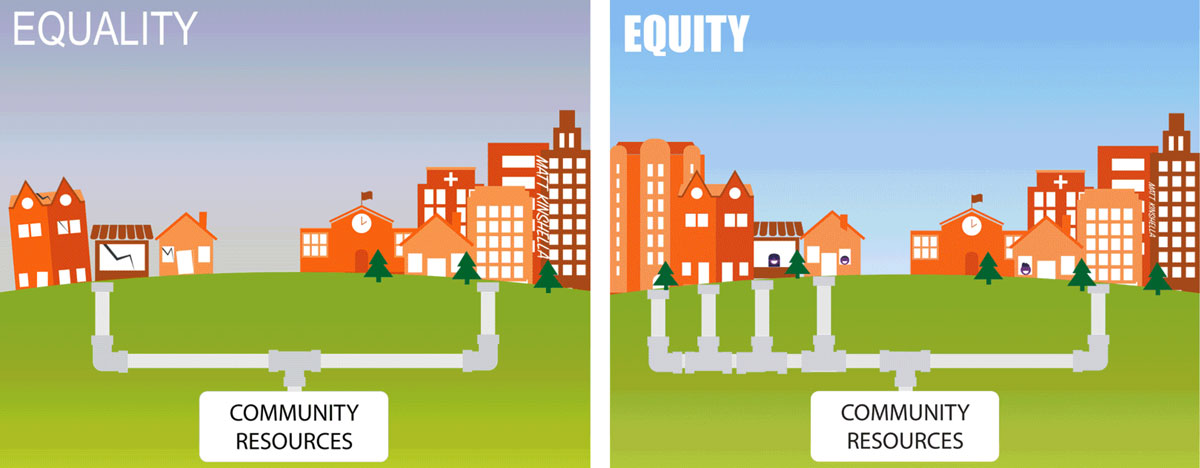
Illustration of equity and equality

We believe that this work would get a kick start if our professional associations could provide training materials to help transform our workplaces and organizational cultures. Building off of the American Alliance for Museums’ guides for transgender inclusion, ALA’s Diversity Standards: Cultural Competency for Academic Libraries, and other resources, our team will create three toolkits to provide a common framework for analysis, a shared vocabulary, and best practices to address systemic inequities specific to the scholarly communications community. Highlighting specific actions to accelerate progress, the toolkits will assist organizations in establishing best practices, help bias-affected individuals break down barriers, and encourage colleagues to advocate for others. The toolkits will introduce foundational equity concepts based on a racial equity model and applicable to inequities related to gender, ability, ethnicity, race, age, and sexual orientation.

  • The organizational guide will provide tools for understanding institutionalized racism and other systemic problems, broadening hiring and recruiting, working to correct bias, including historically marginalized perspectives in decision-making, developing retention plans, pipeline development, creating affinity groups and mentorship programs, broadening accessibility through best practices, and supporting trans and gender non-conforming people.
  • The guide for underrepresented groups will provide an analysis of power and advantage as well as tools for handling microaggressions, advocating for policy changes, filing a complaint, building mentorship relationships, and expanding career paths.
  • The allies’ guide will provide analyses of power, advantage, and unconscious bias; best practices for bystanders; and tools for advocating for policy changes, identifying microaggressions, and building mentorship relationships.

By applying racial equity principles to the development of our materials, we hope to provide organizations with tools that will help them to fundamentally reevaluate core elements of their structure. We have often heard frustration voiced by individuals involved in diversity work—it can be difficult to convince employers that diversity does not end at hiring, and efforts by committees and task forces can stall out if there is not broad awareness of how inequality pervades every part of our workplace culture.

In distilling key equity concepts into accessible language and proposing actionable changes and best practices specific to our industry, we hope to shift the conversation from diversity to inclusion and, in doing so, help create workplaces where all individuals are valued, are set up for success, and where they will see themselves reflected.

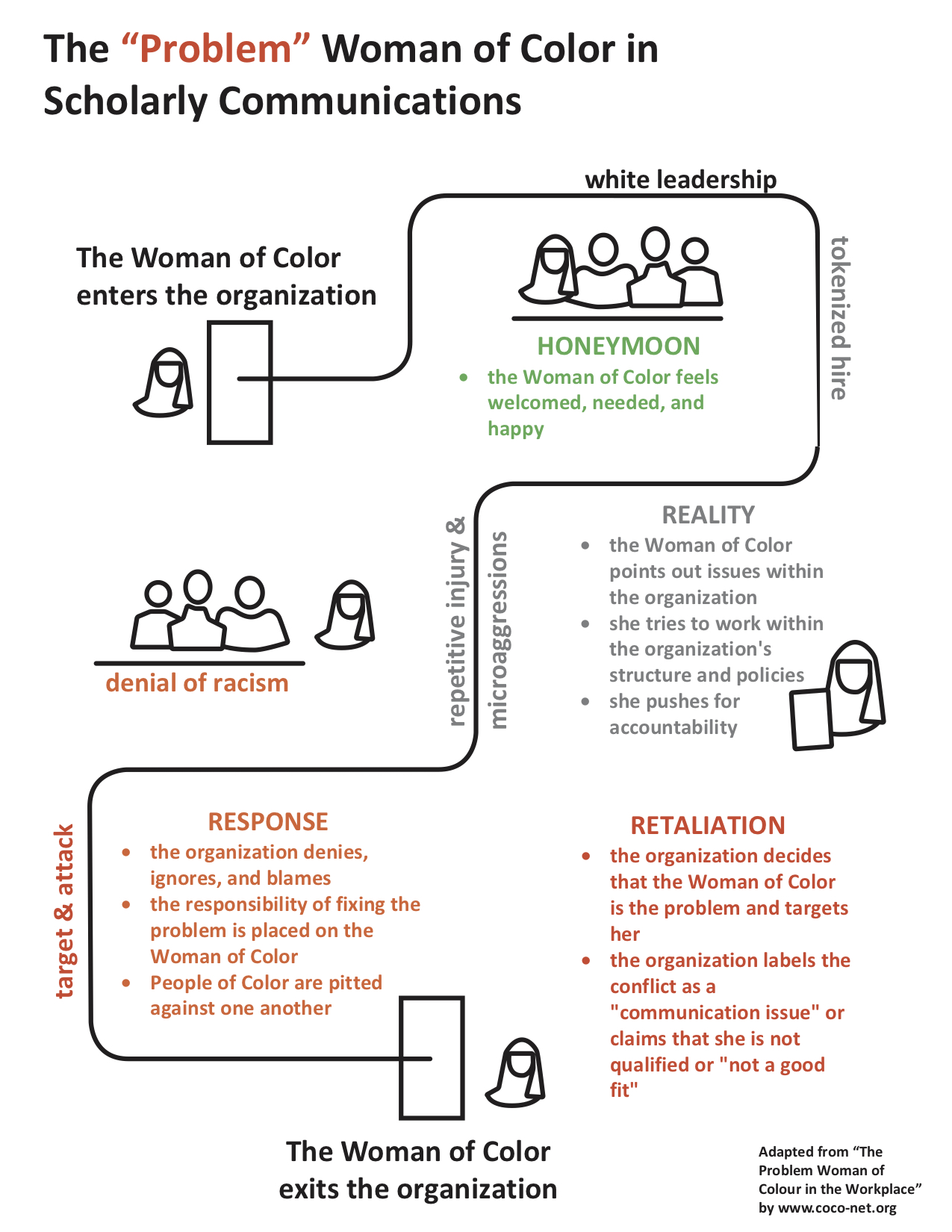
Diagram depicting the "problem" of women of color in scholarly communications

Our Team

Niccole Leilanionapae‘aina Coggins is the editorial, design and production coordinator and assistant project editor for the University of Virginia Press. Niccole was a Mellon University Press Diversity Fellow at the University of Washington Press, where she was able to combine her lifelong interests in racial identity and indigenous sovereignty by working on books in Asian American and Indigenous studies, and American and environmental history.

Jocelyn Dawson is journals marketing manager at Duke University Press. Jocelyn serves on the AUPresses’s Annual Meeting Program Committee and is a previous member of the SSP’s Board of Directors. Passionate about equity and inclusion topics, she serves on SSP’s Diversity, Equity and Inclusion Committee, plays an active role in E&I efforts at Duke University Press, and has authored four pieces about diversity for The Scholarly Kitchen.

Melanie Dolechek is the Executive Director of SSP and previously served as the Director of Publishing and Marketing at Allen Press. She plays an active role in the Coalition for Diversity & Inclusion in Scholarly Communications (C4DISC), is an advisory board member of the Workplace Equity Project, and currently serves as treasurer of the Kansas City Society of Association Executives.

Gisela Concepción Fosado was a member of both AUPresses’ Diversity and Inclusion Task Force and AUPresses’ Gender, Equity, and Cultures of Respect Task Force. In 2016, she co-founded a grassroots staff group at Duke University Press focusing on equity and inclusion. As an Editor at Duke, Gisela publishes books across the humanities and social sciences, with an interest in books that foreground marginalized perspectives, adopt an intersectional approach, and contribute to our understanding of social movements and inequality.

As a co-founder of the Workplace Equity Project, a grassroots research, communication, and advocacy organization, Susan Spilka developed a marketing and communications strategy that yielded endorsements from major scholarly publishers, professional organizations, and UN Women UK, and participation from nearly 1,200 respondents. Having led Corporate Communications at Wiley for two decades, Susan now provides strategic communications, public relations, business development, and research services for scholarly publishers and technology services. She currently serves on SSP’s Diversity, Equity and Inclusion Committee.

Toolkit Dissemination

After the toolkits are finalized, we will

  • work with C4DISC member organizations to solicit feedback and encourage adoption.
  • seek endorsements from organizations across scholarly communications, starting with members of C4DISC and their boards.
  • increase awareness of and buy-in to our resources by preparing conference panel proposals for AUPresses (Association of University Presses), SSP (The Society for Scholarly Publishing), and other C4DISC member conferences, collaborating with members of these groups’ diversity and inclusion task forces and committees.

[ Equality/Equity illustration by Matt Kinshella, used here by permission. The “Problem” Woman of Color in Scholarly Communications illustration was adapted from a tool created by Emily Yee Clare and Kira Page at the Centre for Community Organizations (COCo), and is used here by permission. The graphic design was done by Sanjeevan Tharmaratnam. The original was adapted from a tool made by the Safehouse Progressive Alliance for NonViolence. Please contact the original creators if you wish to reproduce these images.]