Story Structure and Storytelling Performance Techniques to Translate Scholarly Work

This is the fourth in a series of posts about each of the teams that will be attending SCI 2017, and their projects. This one was submitted by Brian Sturm.

Photo of man shining a flashlight into the night sky

In the last decade, “story” and “storyteller” have become immensely popular concepts in a wide variety of contexts. Corporations have adopted the term for marketing products (content marketing), organizational branding (transmedia storytelling), and management strategies.  Fiction writers, movie producers, and video game designers are acclaimed as “superb storytellers.” Even scientists, however tentatively, are seeking to co-opt the words as they try to find ways to make science more accessible.

Story has gained prominence in popular culture since the “storytelling renaissance” in the US began in 1980 with the establishment of the National Association for the Preservation and Perpetuation of Storytelling (now known as the National Storytelling Network).  Scholarship suggests that humans are wired to think in story (Fuller, 1991); that story improves comprehension, memory, literacy, meaning, motivation for learning, and engagement or involvement (Haven, 2007); and that people experience stories as if they were real (Sturm, 2000), leading to increased empathy and connection with each other (Manney, 2008).

In short, storytelling and story structure are immensely powerful communicative tools, and it is timely that the Institute is addressing their value in fostering scholarly communication.  The primary challenge for this working group is to answer the question, “How can we use storytelling techniques and story structure to help translate scholarly productivity and dissemination into a more accessible and memorable format?”  We view “productivity and dissemination” broadly, so that it includes: research articles, conference papers and presentations, research posters, as well as face-to-face and online teaching.

This working group is dedicated to designing a workbook of options to help scientists in different disciplines understand the processes involved in applying story structure and performance techniques to their work.  We intend to start with broad-stroke brainstorming sessions to capture the wealth of ideas our diverse backgrounds provide, and then focus on designing templates and processes for academics to follow that will help them translate their scholarly work into formats that harness the power of story.  Different disciplines have different expectations for their “products,” so we envision needing to develop different options for each, as one story or structure will not serve all disciplines.

Working Group Participants

We have assembled a team that builds on many of the strengths of collaborative teams.  The members are interdisciplinary, with expertise in folklore, linguistics, music performance, music and storytelling therapy, and library and information science.  All of the members are seasoned performers in their areas and combine to bring both the academic/theoretical and practical lenses to this endeavor. All members are published authors of scholarly work.  They bring a diversity of perspectives and an established record of pertinent, scholarly communication to this group.

  • Ruth Herbert, PhD – Ruth is Head of Performance in the School of Music & Fine Arts at the University of Kent, UK.  She is a music psychologist and performer with diverse research interests in the fields of music in everyday life, music, health and wellbeing, music and performance psychology, phenomenology, evolutionary psychology and ethology. Her book, Everyday Listening: Absorption, Dissociation and Trancing is published by Routledge (2011). From 2012 to 2015, Ruth led a 3-year nationwide study of young people’s listening as a British Academy Fellow at Oxford University. She is currently co-editing a book on music and consciousness for OUP and has published many academic papers. Ruth shares a scholarly interest in modes of experiential engagement with Brian Sturm.  Her real strength to this working group is her unique approach to “music as story,” her knowledge of the “absorbing power of music,” and her perspective on assessing the relevance of the templates we hope to develop to disciplines outside the knowledge of the rest of the group.
  • Rob Parkinson, MA – Professional storyteller, multi-instrumentalist, songwriter and author, Rob has over thirty years’ experience working in all sorts of performance and workshop contexts in the UK and internationally. He is a former Chair of the (English) Society for Storytelling. Rob is also a widely experienced therapist and the current director of The Brief Therapy Centre in Tonbridge, UK, where he has trained many professionals in the use and relevance of stories and storytelling approaches to therapeutic change.  He is the author of acclaimed Transforming Tales: How Stories Can Change People. (Jessica Kingsley Publishers, 2009) and several other titles on the practical skills and the relevance of storytelling to many forms of communication.
  • Monica Sanchez, PhD – Monica is a former linguistics professor at Brock University in Canada, whose interest in storytelling spawned the International Conference on Storytelling in 1999, the proceedings of which resulted in Storytelling: Interdisciplinary and Intercultural Perspectives (2002). Monica also brings a unique perspective that will help broaden the applicability of our proposed templates; of all of the disciplines represented in this working group, linguistics is the most like mathematics, and her expertise in analytical thinking and her training in argumentation will help broaden and deepen the group’s thinking and the dissemination of the results.
  • Kay Stone, PhD – Kay is a renowned folklorist and storyteller from Canada. She taught storytelling and folklore classes at the University of Winnipeg for nearly 30 years, and is the author of several books on story, including Some Day Your Witch Will Come (selections from her scholarly articles), Burning Brightly: New Light on Old Tales Told Today (interviews with modern North American storytellers), and The Golden Woman: Dreaming as Art. She has written extensively about women in folktales and feminist approaches to folklore, and has expertise in modern oral narration.
  • Ruth Stotter, MA – Ruth is from California and is the former director of the Dominican University Storytelling Program, where she designed curriculum and supervised six faculty members. She has been a self-employed teacher, author, and storyteller for the past 35 years, and is the recipient of the National Storytelling Network’s Oracle Lifetime Achievement in Storytelling award (2011).  She brings a wealth of folkloric and storytelling knowledge to the group, and is the author of About Story: Writings on Stories and Storytelling, 1980-1994, and its sequel, More About Story: Writings on Stories and Storytelling, 1995-2001.
  • Brian Sturm, PhD – Brian has researched the immersive power of storytelling and narrative worlds for nearly 20 years.  He teaches storytelling and public library work with children in the School of Information and Library Science at the University of North Carolina at Chapel Hill, and he brings that unique perspective to the group.  His research explores engagement in narrative environments of all kinds (digital, performative, and print), and he has recently developed a course in storytelling and social equity. He is the co-author of The Storyteller’s Sourcebook, 1983-1999 (Gale, 2001), a motif index to children’s folktale collections. He spent one month in Thailand in 2002 as a Fulbright Scholar sharing stories and providing workshops, where he helped develop a children’s literature doctoral curriculum for Mahasarakham University, and recently concluded a 27-day lecture & workshop tour of eastern China.
Photo of a man sitting in front of a wall of paintings

Dissemination and Follow-up Activities

Our workbook will be available on the open web and may lead to a book contract eventually.  To accomplish this, follow-up work will continue amongst the group, and we will seek to bring in other scholars from unrepresented disciplines (such as the sciences) to flesh out our initial ideas.  Depending on the composition of the groups accepted to the Institute, this working group may provide a completely unique set of perspectives for the Institute as a whole.  Collaborations function best when those working together provide myriad lenses on the issues, and this group certainly does so.

References

Fuller, R. (1991). The primacy of story. In Context, 27, 26-28. Available: http://www.context.org/iclib/ic27/fuller/

Sturm, B. (2000). The storylistening trance experience. Journal of American Folklore, 113, 287-304. Available: http://www.jstor.org/stable/542104.

Haven, K. (2007). Story proof: the science behind the startling power of story. Westport, Conn: Libraries Unlimited.

Manney, P. J. (2008). Empathy in the time of technology: how storytelling is the key to empathy. Journal of Evolution and Technology, 19, 1, 51-61. Available: http://jetpress.org/v19/manney.htm

[ Photos by Dino Reichmuth and Beata Ratuszniak used under Unsplash free license. ]

Telling Medieval Stories

This is the third in a series of posts about each of the teams that will be attending SCI 2017, and their projects. This one was submitted by Brandon W. Hawk.

Image from an illuminated manuscript - Weltchronik

If storytelling matters in our own contemporary context, then so too do stories from the past. Unfortunately, premodern tales often remain obscured or misrepresented.

For example, in the twelfth century, the English monk Thomas of Monmouth (fl.1149-1172) fabricated a story about Jews kidnapping and murdering a boy named William. This fiction, now known as the “Blood Libel,” continued to be told in various forms throughout the Middle Ages (see “The Prioress’s Tale” in Chaucer’s Canterbury Tales); and it survives as a “zombie lie” even up to our own time, where it is still retold, often as history. As propaganda fodder for the far-right, however, the (mis)understanding of the Middle Ages evoked by contemporary retellings of the Blood Libel is racist, bleak—and completely misses much of what the medieval period has to offer to contemporary culture.

Our working group is comprised of a team of medievalists (academics, public scholars, journalists, activists) who want to engage the public with stories from the Middle Ages. Collectively, we want medievalists to be seen as public scholars by other public scholars.

During the Institute, we want to create a new roadmap toward public writing where we can deploy our academic skills for the widest possible audiences. We want to be recognized as storytellers who tell old stories that matter, and tell them to the twenty-first century. We want medievalists to plot to carve more space out of the mainstream media. We want to imagine the next type of The Toast, and to lay the groundwork to make it happen.

Our working group includes a cross-section of people who identify as medievalists, at various stages in their careers, working with different storytelling media to engage the public by telling medieval stories. Some of us are teachers and researchers in higher education, but some of us also have experience as journalists, public scholars, social media mavens, and consultants for film, television, and radio. Notably, all of the participants on this team are actively engaged in social media, especially through blogging and tweeting. One of our goals is to bring our interdisciplinary and inter-experiential voices together to learn from each other and to find new modes of storytelling in our own work and with others interested in similar pursuits.

We hope that participating in the Institute can develop a network and team among ourselves and reaching out more broadly, so that we can collaborate and speak more loudly together as medievalists even as we tell more diverse stories.

We are also curious what we might learn about so-called “futurists”—scholars apparently hired by think tanks, companies, and governments to write white papers that imagine future conditions, technologies, and their impacts on society and government. Modernists are usually offered such work, but we feel strongly that medievalists, those of us who study the origins of the very nation-states and technologies in question, are uniquely suited to such scholarly communication.

In all of this, we want to get better at teaching the narratives of the Middle Ages as contested ground both in medieval and modern contexts. From telling our stories, we want to forge connections between the premodern and contemporary, encompassing the longue durée, about violence across religious identities and histories of race; the unravelling of the myth of the “white” Middle Ages and “white” Western Civilization; untold histories of technologies leading to the so-called “digital age”; questions about gender and sexuality—none of which are by any means new in our contemporary era.

Some of our goals raise obvious questions and challenges:

  • What do we mean when we talk about telling medieval stories to the public?
  • What does it mean to be academics using more popular storytelling media?
  • How (and why) do we enact scholarly communication as medievalists, for the public, and through diverse storytelling media?
  • How do we break in?
  • How do we do it accessibly?
  • What new models of publication need to be established to achieve our goals?
  • What can we bring to the public to show them medieval subjects matter?

There are some obvious answers to these questions, but also some less obvious answers that we want to work through in a network with others who are asking similar questions.

Medievalists, like medieval people, are all about networks. The Tale of Audun from the Westfjords poses one example, about a poor, resourceful, Icelandic merchant driven by luck to sail to Greenland, spend all of his money buying a captured polar bear cub, sail around Europe with the bear hustling kings, create a network of contacts from his experiences, and ultimately gain widespread reputation and enough wealth to settle into early retirement back in Iceland.

While fictional, the example is representative of the types of networks that pervaded the medieval world. Without networks, people went nowhere.

Our group at the Institute will capitalize on expanding our network: this is one of the substantive takeaways for us. We want to use our time at the Institute to create a plan for not only reaching the public through scholarly communication but also reaching others with the same goals. We will identify who else will take part in our plans; who will invite us to write in their networks; who will collaborate with us to shape the narrative of medieval studies going forward—not just our own group’s narrative. Our connection, our mesnie, our group of well-willers will expand, and our opportunities will grow, as will the patronage we can extend in turn. This profound reciprocity of networking is precisely what is missing from contemporary far-right understandings of the Middle Ages.

We suggest that scholarly communication needs to get a little more medieval.

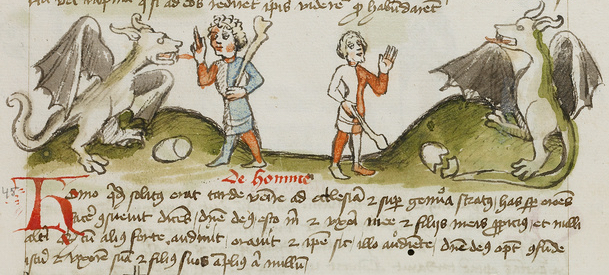
Image from an illuminated manuscript - A Dragon and a Farmer with a Club

Team Members

Brantley L. Bryant is Associate Professor and Department Chair of English at Sonoma State University in Rohnert Park, California. His research and publication has examined medieval literature and history, medieval afterlives in popular culture, and engagement with scholarship on social media. Bryant’s most recent project is the Open Access Canterbury Tales, which aims to bring professional scholarship on Chaucer’s work to a broad new audience through open access formats. He is also creator of popular social media projects Geoffrey Chaucer Hath a Blog and Chaucer Doth Tweet (with over 68,000 followers), parody-tribute accounts in which a Chaucer persona writes about present day events in a version of Middle English. Bryant’s work engages with the crucial issue of telling the story of scholarly research to a broad public.

Brandon W. Hawk is Assistant Professor of English at Rhode Island College. As an early career apasionado, he wants to share his own obscure interests with anyone who will pay attention. Hawk has contributed to academic collaborative blogs like Modern Medieval and the History of Christianity Blog, and he continues to post regularly on his own site, brandonwhawk.net. Recently, he is especially interested in translating and presenting underappreciated medieval subjects for all types of readers; some examples may be seen in his translations of Old English literaturehis project about Judith, and his work on the Gospel of Pseudo-Matthew.

Kathleen E. Kennedy is Associate Professor at Pennsylvania State University- Brandywine where she teaches English and History classes. She is a first-generation college student from a rural area who earned advanced degrees in two fields and eventually tenure in Medieval Studies. Storytelling is her lifeline, since as a perpetual outsider it falls to her to explain why she isn’t like the people she lives and teaches among. She is always asked to explain her difference and she always answers with a story (or two). She has written about the mainstream media’s need for storytelling by rural people for the LARB. She tells medieval stories to the mainstream media too, reminding Game of Thrones fans over and over that medieval history was frequently more humane (and more diverse) than our modern fantasies of it. (In)famously, Kennedy tells the story of the discovery of calculus to humanities audiences, and they love it every time.

Dan Kline is Professor and Chair of English at University of Alaska Anchorage. He specializes in Middle English literature and culture, literary and cultural theory, and digital medievalism, and his research concerns children, violence, and ethics in late-medieval England and neomedievalism and digital gaming. He has published chapters in (among others) the collections Mass Market Medievalism (MacFarland, 2007) and Cultural Studies of the Modern Middle Ages (Palgrave, 2007). He edited Medieval Children’s Literature (Routledge, 2003), the Continuum Handbook of Medieval British Literature (Continuum, 2009), and Digital Gaming Re-Imagines the Middle Ages (Routledge, 2014), and co-edited, with Gail Ashton, Medieval Afterlives in Popular Culture (Palgrave-Macmillan, 2012). He is the author/webmaster of The Electronic Canterbury Tales.

Stephen Yeager is Associate Professor of English literature at Concordia University in Montreal. His current research explores the role of scholarly medieval studies and popular medievalism in the joint evolution of programming languages, internet protocols, videogames, and digital humanities methodologies. Before beginning his academic career he was online editor for Philadelphia and Boston Magazines, and he has been interviewed on the subjects of online education and Tolkien’s medievalism for MacLean’s magazine and CTV News respectively.

[ Post edited on October 3 to reflect a change in the composition of the team, as one participant listed earlier is no longer able to attend. ]

[ Images from the J. Paul Getty Museum, used under CC-BY license from the Getty’s Open Content Program. Sources linked from images above. ]

Using Storytelling to Share Research in a Time of Mistrust

This is the second in a series of posts about each of the teams that will be attending SCI 2017, and their projects. This one was submitted by Franny Gaede.

For the 2017 Triangle Scholarly Communication Institute, our group will look at how storytelling techniques, specifically those used in journalism and folklore studies, can be used to help combat anti-intellectualism faced by scholars and reporters. This idea came from discussion about current information culture (i.e.: “alternative facts” and “fake news”), how scholarly research has been mis- or underrepresented in news media, and how “bad science” and retractions have promoted public distrust of scholarship.

Man reading a newspaper in a doorway

Institutions of higher education are often characterized as bastions of liberalism, which in a politically charged environment will hinder academics’ ability to communicate effectively with the public. This perceived politicization affects the research output of colleges and universities and the ability of the news media to cover research-based stories as they compete for the attention and confidence of their audience. Democratization of information has exacerbated this to some extent. The reduction or elimination of gatekeepers has enabled scholars to engage in disseminating their research but has also contributed to the spread of misinformation and made evaluating information far more difficult.

Scholars have also expressed concerns about sharing their work widely for fear that it will be misinterpreted (see The Heartland Institute’s 500 Scientists with Documented Doubts of Man-Made Global Warming Scares, featuring a number of scientists who later came out protesting their inclusion on the list suggesting their research had been misinterpreted)1, 2 or targeted for grant revocation (see HR 5155, proposed legislation prohibiting the NEH from funding the Popular Romance Project and similar projects.) Still other scholars show a lack of interest in sharing their work with the public as  they report believing the people who need access to their work – other researchers – already do; this, in turn, can help reinforce the idea among the general public that these researchers are elitists locked in their ivory tower.

We intend to approach this problem from the perspectives of educators, folklorists, journalists, librarians, and researchers. Our proposed solutions will involve the use of personal narratives to help make real people the face of the issue at hand and help add empathy to discussions about research and scholarly output. We’ll focus on supporting researchers, librarians, and other involved parties who use or want to use popular/populist platforms like blogs, Twitter, Instagram, and podcasts and offer primers on different methods for evaluating impact.

Our goal with this approach is, as stated in the Call for Proposals, “build bridges with constituencies that normally don’t feel connected to universities, and who may even feel antipathy to them.” We would like to engage these constituencies using storytelling techniques borrowed from journalism and folklore and ideas gleaned from popular “edutainment” and popular science entities, including I Fucking Love Science, lol my thesis, TED Talks, and the VlogBrothers’ Crash Course series. We also want to look at entities engaged in repackaging complex topics, such as eLife Digests, Vox, News in Slow, and Thing Explainer to consider how plain-speaking in scholarship can encourage engagement.

The team includes scholars engaged in research on fairy tales, digital humanities, social justice, sex education, experiential learning, digital storytelling, scholarly communication, and diversity in news, among other research interests. We hold positions ranging from tenure-track faculty to blogger to full-time librarian to alt-ac scholar, having worked in newsrooms, classrooms, and libraries. Between our collective interests and our collective experience, we have the necessary perspective to productively engage in our proposed topic at TriangleSCI and successfully produce the toolkit outlined below.

Newspaper stand in the snow

Team Members

Franny Gaede. Scholarly Communication Librarian at Butler University, liaison librarian for the Department of Modern Languages, the Department of Philosophy, Religion, and Classics, Honors, Global and Historical Studies, and First Year Seminar. My particular research interest is social justice and open access and I work mostly with faculty and undergrads. I feel strongly that accessibility to research ought to include accommodations, access, and readability. You should not need a PhD in a subject to be able to read about it! In addition to my deep interest in scholarly communication, I am an amateur designer with many feelings about fonts, a keen observer of the tech industry, and a five-time participant in National Novel Writing Month.

Jeana Jorgensen. Alt-ac scholar (currently a lecturer at UC Berkeley; home base is adjuncting at Butler University). I research gender and sexuality in fairy tales, narrative folklore more generally, digital humanities, dance, body art, queer and feminist theory, and the history and cultural reception of sex education. My college courses span folklore, anthropology, and gender studies, focusing on teaching students to identify the intersections of cultural context, narrative, and identities. I also blog at Patheos.com and Conditionally Accepted, and have guest blogged widely, contributing to my mission of scholarly outreach.

Ashley Rosener. Grand Valley State University liaison librarian for the School of Social Work, the School of Public, Nonprofit, and Health Administration, and the Johnson Center for Philanthropy. I work with both undergraduate and graduate students and regularly provide instruction, both in the classroom setting and through workshops for students and faculty/staff. I work with students and faculty one-on-one, helping them find reliable sources for their assignments and research. I also maintain the library collections (books, journals, films, databases, etc.) for my liaison areas. I bring to this group my expertise as a liaison librarian alongside a passion for and engagement in scholarly communications issues.

Teresa Schultz. Teresa Auch Schultz is the scholarly communications and copyright librarian at the University of Nevada, Reno, where she advocates for open access of scholarly articles and other work among the UNR community. Previously, Teresa worked as a reporter for local newspapers in Indiana for 10 years. Teresa is interested in new forms of scholarly communication, such as open access, and how research can be made accessible to everyone, not just academia in the Western Anglo world. Her background as both a scholarly communications librarian and journalist will help contribute a knowledge of how researchers work and what motivates them and how that fits with traditional storytelling methods used by journalists to communicate to the public.

Jessica Sparks. Jessica Sparks is a former political reporter from Indiana who transplanted to the South. With a bachelor’s in journalism and a master’s in digital storytelling, she has served in several roles for news organizations. In 2013, Sparks was part of the first cohort of the International Center for Journalists “Back to the Newsroom” fellowship, where she worked for the Wall Street Journal. Her research areas include journalism, gender issues, diversity in news and newsrooms, and social media. At Savannah State University, Sparks teaches undergraduate mass communications courses focusing on writing, news reporting, research methods, and basic design principles.

Amanda Starkel. Information Commons and eLearning Librarian, Butler University. As Information Commons and eLearning Librarian, I manage the students and staff who run our service point in the library. Our program is focused on experiential learning and includes assessed student learning objectives and peer teaching.  I also maintain traditional liaison responsibilities such as instruction, assessment, collection management, and outreach. Before Butler, I served as Interim Director and Instruction Librarian at Defiance College. My expertise is in user services and information literacy instruction, but I excel at thinking creatively to solve problems and offer broad academic experience to this group.

Output

Our intended output is a toolkit that will include the following items:

  • Breakdown of different storytelling genres, including classical folklore genres and pop culture examples to help users harness generic associations and aid them in making certain points or reaching specific demographics
  • Advice for researchers on building pre-made video news releases, interactive infographics, and podcasts, including guidance on using humor, emotion, and personal narratives to encourage understanding, empathy, and sharing (i.e.: how to go viral)
  • Unbranded, editable Creative Commons-licensed templates to be used on social media to share research

[ Photos by Thong Vo and Matt Popovich used under Unsplash free license.]