Promoting a Public Face for Scholarly Journals

This is the third in a series of posts about each of the teams that will be attending SCI 2018, and their projects. This one was submitted by Stephen Robertson.

Photo of flower against a yellow background

What can be done to expand the online presence of scholarly journals to promote broader public engagement with the research they publish?

Attacks on academic institutions generally and the humanities specifically have increasingly inspired scholars to make their work more accessible to the broader public. Many intend for their work to contribute to the pursuit of social justice and, as articulated by the African American Intellectual History Society, to “shed light upon and critically analyze issues of relevance to the public.” Online platforms are promising options for reaching such goals, both by supplementing and enhancing more traditional forms of scholarship and by revealing scholars’ research and writing processes.

Groups of scholars and professional organizations have already begun engaging the public online. Nursing Clio, Notches, NiCHE, and The Junto are among the leading scholar-driven blogs; the African American Intellectual History Society’s Black Perspectives and the Society for US Intellectual History’s USIH blog are prominent examples of online publications by organizations. Scholarly journals, however, have been slow to engage with emerging forms of scholarly communication beyond digital delivery of articles and have played a limited role in promoting public engagement with scholarship.

Online platforms for digital versions of print publications give many journals an online presence, but one restricted to subscribers and controlled by publishers not editors. Beyond articles, those sites provide only editorial information. Some journals have a social media presence, generally limited to broadcasting the contents of each new issue. A small number of journals have begun to develop websites outside the paywall to promote and expand on content: for example, The Panorama from the Journal of the Early Republic; the Journal of the History of Ideas blog, and The Docket, under development by the Law and History Review. None of these sites yet involve significant interaction with readers, however.

And yet, journals are uniquely positioned to make distinctive contributions to promoting public engagement; as publishers, they have access to scholarship that scholars and even scholarly organizations do not, and can, thus, more directly connect audiences with research. Journals also offer an umbrella that makes public engagement less ephemeral and more visible, and a less professionally risky undertaking for scholars.

What often holds academic journals and societies back from developing accessible, public content is that change involves risk as well as the investment of limited resources—financial as well as human. It requires the use of digital platforms and tools that currently may not be part of a journal’s portfolio. Content for such platforms often differs from what journals currently publish, making the support and management of such content challenging. Moreover, the effort required to launch such public facing initiatives is just the first step; they also must be maintained. While a handful of journals have successfully developed some form of public face, it is not enough to make the risks appear manageable to others who might otherwise be interested.

Photo of glowing statues at nightWe will explore what can be done to reduce risk in creating a public face for scholarly journals, using history journals as a case study. We will ask a variety of questions, including:

  • How could journals promote public engagement using existing platforms—websites; social media; audio and video media; and annotations—and practices—online material that expands on the content of articles and the research and methods they employ; forums that connect authors and readers; author interviews; content shaped for non-scholarly audiences; and content that engages with contemporary issues and discussions?
  • How could journals compliment and engage with other scholars and organizations promoting online public engagement?
  • What resources and training would make developing an online presence more efficient and effective?
  • How can we make an online presence that integrates public engagement and scholarly publication a pattern of scholarly communication expected of journals?
  • How can we set realistic metrics for success?
  • What kind of reach can be expected in a crowded media landscape?
  • Are there ways we can work together to expand this reach and support rather than compete with each other for reader attention?

Our team:

Lisa M. Brady is professor of History at Boise State University and editor in chief of Environmental History. Her research examines the intersection of war and environment and her current project is a history of conflict on the Korean peninsula over the course of the 20th century. As editor, she undertook the expansion of Environmental History’s supplemental website (www.environmentalhistory.net) and appointed its first dedicated Digital Content Editor to oversee such online-only features as “Field Notes,” peer-reviewed essays focused on the process and practice of doing environmental history. She also works closely with her publishing partners at Oxford University Press to promote the journal’s content through virtual issues (open access, drawn from articles previously published, curated around a timely issue) and other projects.

Liz Covart is the Digital Projects Editor for the Omohundro Institute of Early American History and Culture at the College of William and Mary. In 2014, she founded Ben Franklin’s World: A Podcast About Early American History, which seeks to create wide-public awareness about early American history and the work of professional historians. As the OI’s Digital Projects Editor, she now produces and hosts Ben Franklin’s World for the OI and plays a leading role in the organization’s multi-platform and multimedia initiatives to engage multiple publics with scholarly early American history. These initiatives include creating podcast series to drive listeners to other OI media including articles in the William and Mary Quarterly and using the William and Mary Quarterly and other OI media to drive readers to the podcast. The OI Reader app makes these digital-to-print and print-to-digital efforts possible. It also makes it possible for the William and Mary Quarterly to publish native digital articles and articles with interactive components.

Seth Denbo is director of Scholarly Communication and Digital Initiatives at the American Historical Association, which has as a primary focus of its activities an interest in bringing historical knowledge to as wide an audience as possible. Over the past decade the association has promoted better engagement in public culture by historians, opportunities for historians working outside of academia, and better historical education more broadly. The Association uses its blog and other digital outlets to bring history to bear on contemporary society. Denbo has been involved with the association’s efforts to provide infrastructure for digital scholarship, including guidelines, training materials, workshops, etc. He also works closely the editor of the American Historical Review in exploring ways to engage to bring the scholarship in the journal to audiences outside the academy.

Robert Greene is a Visiting Assistant Professor of History at Claflin University and the book review editor and contributing blogger for the Society of U.S. Intellectual Historians. As a member of S-USIH, Mr. Greene writes about African American and Southern intellectual histories, always with an eye towards writing for a public audience. In addition to his work at S-USIH, Greene has also contributed to the African American Intellectual History Society’s blog, Black Perspectives. He has also delivered papers at the first two AAIHS conferences, in Chapel Hill in 2016 and Nashville in 2017. Also, Mr. Greene has written for numerous public outlets, such as Dissent, Jacobin, Scalawag, The Nation, In These Times, and Politico. For all these outlets, and others, Mr. Greene has written about the intersection of history with current events and modern politics.

Catherine Halley is the editor-in-chief of JSTOR Daily (daily.jstor.org), an online magazine and newsletter published by JSTOR that provides scholarly context for news for a general, nonacademic reader. Based on the peer-reviewed, scholarly research available on JSTOR.org, JSTOR Daily (@JSTOR_Daily) stories encourage lifelong learners to take a deep dive into news headlines and/or a step back to discover the origin stories of topics as diverse as fake news and potato chips. The magazine covers a wide range of subjects from arts and culture to science and technology, and draws on scholarship from fields as diverse as physics and sociology. All readers get free access to the scholarship cited in JSTOR Daily stories. Halley has taught academics how to pitch editors at non-academic publications and specializes in cultivating wider audiences for academic and otherwise arcane knowledge. Prior to launching JSTOR Daily, Halley was the digital director at the Poetry Foundation, where she launched the popular Poetry from the Poetry Foundation mobile app and used technology and social media platforms to create a popular audience for poetry.

Stephen Robertson directs the Roy Rosenzweig Center for History and New Media (RRCHNM) at George Mason University, which uses digital media and computer technology to democratize history.  The Center collaborates with practitioners and audiences engaged with history in universities, schools, libraries, archives, museums, and communities. He is co-organizer of RRCHNM’s new annual conference and peer-reviewed online journal Current Research in Digital History. For his own project, Digital Harlem, Robertson has developed a blog to make the site accessible to users and present stories based on its contents. He also brings to the workshop extensive experience in developing and offering training in digital literacy and skills.

Follow-up Activities

The result of our meeting will be a guide to platforms and strategies for public engagement which we would disseminate online, and present at the journal editors’ breakfast at the 2019 American Historical Association conference. Depending upon the needs and approaches that emerge from our conversations, we could also pursue funding for workshops, online resources, and hosting and technical support to help journals create an online presence.

Prior to the Institute, we plan to undertake a survey of editors of historical journals through the American Historical Association and the Conference of Historical Journals to gather information on their specific interests, concerns, and needs in regards to developing a public online presence.

[ Photos by Alex and Steve Roe on Unsplash used under Unsplash free license. ]
TRANSPOSE – TRANsparency in Scholarly Publishing for Open Scholarship Evolution

This is the second in a series of posts about each of the teams that will be attending SCI 2018, and their projects. This one was submitted by Tony Ross-Hellauer.

Photo of a canoe in clear water

Context

Journal policies shape Open Scholarship practices and safeguard against legal and ethical risks in publishing. Journal policies are an under-investigated element of Open Scholarship, however. This is unfortunate, since Open Scholarship requires publication policies that are aligned with its aims in order to reduce the transaction costs – and thereby career risks – for researchers that want to practice transparent, inclusive, and collaborative research. Such transaction costs are exacerbated by obscure or only implicitly stated journal policies; a lack of central resources to monitors such policies; and a lack of data-sharing from publishers regarding their publication processes. In the move towards Open Scholarship, researchers are expected to open up their research to transparency and scrutiny; the same should be expected of academic publishing.

TRANSPOSE (TRANsparency in Scholarly Publishing for Open Scholarship Evolution) is a new, grassroots initiative to address SCI 2018’s theme of overcoming risk:

  1. Risk to researchers: For researchers, and especially early career researchers, Open Scholarship means experimenting with new practices for the benefit of scholarship. Such experimentation may put researchers at risk of falling foul of review etiquette, or licensing agreements. This is especially true of those disciplines (such as some humanities disciplines) where such practices are less prevalent. Therefore publishers have a duty of care to inform and educate authors and reviewers about the terms under which they engage with those journals and the consequences of their choices. Obscure policies will often mean that researchers are unsure of their rights and may be dissuaded from innovation out of unfounded fears, thus putting the future of Open Scholarship at further risk.
  2. Risk to the scientific system: Healthy systems innovate, and scholarly publishing should innovate based on evidence. Yet since publisher internal processes are often a “black box” of proprietary information, it can be difficult for meta-research to take an evidence-based approach. Moreover, with current claims of a reproducibility crisis in many scientific disciplines and sky-rocketing publication rates, efficient movement towards Open Scholarship is required. Lack of clarity about Open Scholarship practices in journal policies, and authoritative evidence about the extent of their adoption, impedes such progress.

Such risks manifest themselves in a host of uncertainties. How do policies shape the adoption of Open Scholarship? Who can contribute, and who gets credit? What rights do authors have to post preprints, and when? Are peer review processes functioning as optimally as possible?

Photo of bridge and open skyTRANSPOSE will research these issues to: 1) make clearer to researchers the conditions of engaging in the academic publishing system through greater transparency on policies; 2) quantify the degree to which practices are currently supported to provide an evidential basis for future changes at the policy-level, and; 3) work to increase sharing of data about publisher-internal processes which bear on the quality and process of publication procedures. We’ll examine the following concrete issues:

  • Preprints: Researchers are often afraid of taking steps (such as posting a preprint) because the reaction from journals is unknown. Based upon our surveys (for example, re licensing) they tend to assume the worst: that journal policies regarding the acceptability of preprints, both as submissions and citations, are as conservative as possible. Therefore, the act of making policies and practices crystal clear helps authors to accurately predict outcomes and reduce risk. Furthermore, fears regarding social norms and practices (such as scooping) could be addressed with evidence of their true prevalence, especially as they relate to behaviours that are likely to be protective (ie, preprinting).
  • Unacknowledged reviewing: Early career researchers (namely graduate students and postdocs) may feel hesitant to contribute to peer review done in the name of their supervisor; and supervisors may not disclose names of others involved in review where journal policies suggest such common practices may have punitive consequences. Providing appropriate and ethical credit for their involvement would reduce their risk.
  • Extent of open peer review procedures: A recent meeting demonstrated widespread support for journals in the life sciences posting the contents of peer review. However, currently only 2% of them are doing so. Tracking these practices in one place over time will allow editors and publishers to reconsider practices to match those of their peers.
  • Data-sharing on journal processes: As ECR Libby Pier said in a recent blog post “Until there’s more data on [Open Peer Review] … I think scientists ought to be wary of donating their time and resources to an uncertain process. On the other hand, we can’t obtain more data on the effects of open peer review if we don’t have willing participants. And therein lies the paradox of OPR: We won’t know if it works until more of us try. So for the good of the future of scholarship, perhaps we need to be willing to participate in an experiment of our own collective making.” But ECRs shouldn’t need to expose themselves to risk like this – we need to foster more studies and hence enable an evidence-based approach to changes in processes.

To bring clarity to these issues, we will crowdsource a list of journal policies for (1) open peer review policies, (2) co-reviewer policies, and (3) pre-printing policies. We’ll then look at a representative subset of journals in more detail to systematically taxonomize and analyse their stated peer review and preprinting policies. These initiatives will then be complemented by a strategic discussion on how journals could be persuaded to improve their policies. As a final step, we will work to foster data-sharing in order to more systematically test how these innovations affect the quality and efficiency of scholarly communications, as well as their effects on researchers. These actions will mitigate the risks that adopters of innovative practices run, clarifying options and providing more evidence.

TRANSPOSE has already started and all are welcome to participate! https://transpose-publishing.github.io/

Photo of open sky seen through barn doorsGroup participants

Jessica Polka is Director of ASAPbio, a researcher-driven non-profit working to promote transparency and innovation in life sciences communication. With a background in biochemistry, cell biology and synthetic biology, Jessica has been advocating for the productive use of preprints in these disciplines and is heavily invested in tracking and encouraging policy changes. She recently co-organized a meeting on increasing transparency in peer review in the life sciences (asapbio.org/peer-review/summary). She brings to this project a desire to translate knowledge into community-driven actions that result in policy and cultural change. Jessica will bring her rich experience in community-organisation to bear in driving the crowdsourcing elements of the project, also contributing expert knowledge of the current landscape for preprints and open peer review.

Gary McDowell is Executive Director of Future of Research, a non-profit organization which wants to champion, engage and empower early career scientists with evidence-based resources to improve the scientific research endeavor. Gary currently studies aspects of the academic enterprise as they relate to early career researchers and how they carry out their scholarly work, with a particular focus on systemic workforce issues. Gary’s contribution to this project will be the particular focus on the recognition of scholarship of early career researchers through increased transparency in the peer review process, including efforts to make sure that all who participate in the peer review process and authorship of peer review reports are named as doing so.

Jennifer Lin is Director of Product Management at Crossref, a scholarly infrastructure provider, developing metadata services that make scholarly content easy to find, cite, link, and assess. Jennifer received her PhD in political philosophy and has served as an instructor at Johns Hopkins University. She previously worked for PLOS where she oversaw product strategy and development for research data sharing, article-level metrics, and open assessment initiatives. Jennifer’s role in the project is to provide technical resources for data collection and dissemination in the project as well as more broadly provide background context on the diversity of publishing practices (editorial and production) across publishers.

Benedikt Fecher heads the “Knowledge Dimension” research programme and the “Internet-Enabled Innovation” research unit at Humboldt Institute for Internet and Society, Berlin. In his research he focuses on open science and open access infrastructures. In 2016, Benedikt was also a scientific advisor to the Leibniz Association on the subjects of open access and research data. He has been a mentor in the “Free Knowledge” fellowship for Open Science programme since 2017, supported by Wikimedia, the Stifterverband and the Volkswagen Foundation. Benedikt is also co-editor of the blog journal Elephant in the Lab, which critically engages with the science system and a member of the editorial board of the Open Access journal Publications. Benedikt will bring a social sciences perspective to the team, using theories from Science and Technology Studies to contextualise findings and produce policy recommendations.

Samantha Hindle is Content Lead at bioRxiv, a non-profit preprint server for the life sciences, and co-founder of PREreview.org, a preprint journal club review platform geared towards promoting the training (and acknowledgement) of early career researchers in peer review. Samantha has a background in Cell Biology and Neuroscience and, until recently, was an early career researcher herself. Samantha has seen the benefits of working openly through her involvement in the Mozilla Science Lab and OpenCon communities, and is passionate about enabling policy change that will align the current academic culture with Open Science practices. Samantha’s role in this project will be the focus on visibility of journal preprint and peer review (co-reviewer) policies to overcome the risks associated with pre-printing and engaging in open peer review.

Tony Ross-Hellauer is Senior Researcher in the department of Social Computing at Know-Center GmbH, Austria’s leading research centre for big data analytics and cognitive computing. Tony is Editor-in-Chief of the Open Access journal Publications, and his research on open peer review has received international recognition. He is actively involved in Open Science advocacy and community-building. His research interests include Open Science, new models and infrastructures for scholarly communications, science policy and ethics, alternative models for peer review, and philosophy of technology (in which field he completed his doctoral work). Tony’s contribution to this project will be the particular focus on the evidential basis of the benefits and risks of open peer review (especially for early career researchers) and the need for greater data-sharing to stimulate further research, as well as the broad ethical dimensions of the project more generally.

Photo of pentagonal view down a stairwell

[ Photos by Pahala Basuki on Unsplash used under Unsplash free license. ]

Creating Global Cognitive Justice

This is the first in a series of posts about each of the teams that will be attending SCI 2018, and their projects. This one was submitted by Tom Olijhoek.

A project to explore the language, access and epistemological barriers that put the equity, diversity and inclusiveness of OA scholarly communication at risk in Africa and other areas in the Global South

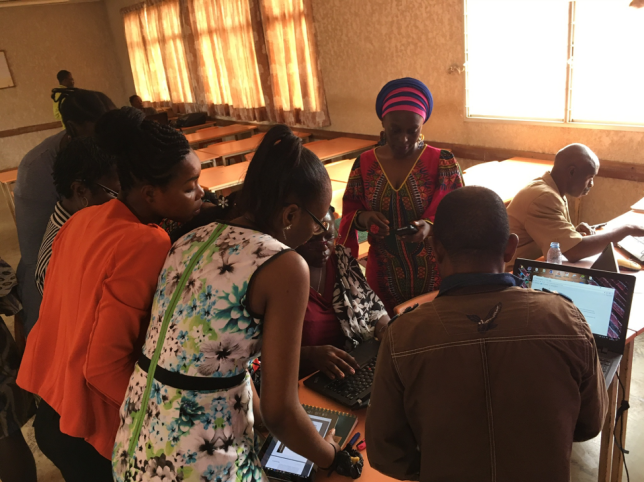
Photo of training session at the Université Catholique d'Afrique Centrale, Yaoundé. Cameroun

Image credit: Prof. Florence Piron, training session at the Université Catholique d’Afrique Centrale, Yaoundé. Cameroun

Defining the problem

Scientific research is not just about advancing knowledge. In today’s world, it is attempting to fulfill two other roles assigned to it by science policy: on the one hand, to contribute to the economic development of a country by generating marketable innovations (knowledge economy) and, on the other hand, to contribute to the common good of a society defined according to its priorities and needs (societal impact).

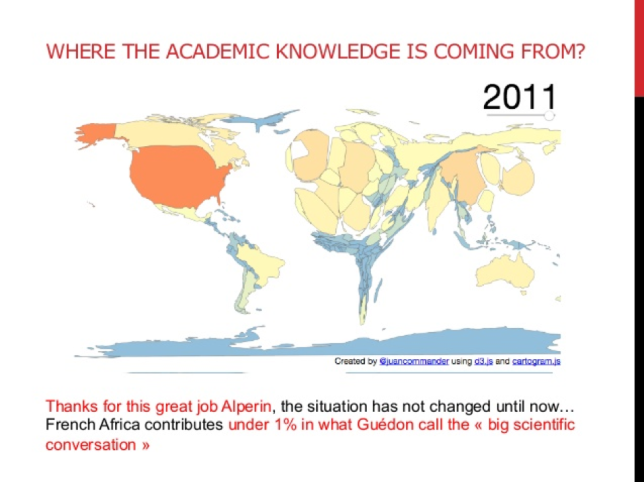
Word cloud of text about open access and knowledge in AfricaIn the Global South, which are plagued by many economic, political, environmental, social or energy problems, scientific research should and could offer a major contribution to the search for solutions. However, as several surveys (Alperin 2013; Gibs 1995) and statistics from commercial databases or from the DOAJ show, research is struggling to emerge in these countries: publications from universities in for example French-speaking Africa are very few, not very visible, not widely read, and so most African universities are more familiar with publications from the North than from their neighbors.

Among the explanations of this phenomenon that we want to explore together during the seminar, the hegemony of the English language on the scientific publishing system comes first (Panko 2017). Indeed, few graduate students, lecturers and professors from French-speaking Africa (where university education is taught in French) are proficient in English. That situation prevents them from fully understanding publications in this language or from publishing articles in English-language journals, the most visible on the web right now.

For researchers, choosing to produce knowledge in their own languages would allow them not only to integrate within it the local world vision and knowledge, but also to maximize the use of this knowledge by their fellow citizens, whether in Economics, Public Service or Civil Society.

The domination of the English language in the publication system entails  a serious risk for researchers from the Francophone Global South (Hountondji 1994, 2001). They want or are expected by their university to publish away from their language and therefore from their first public, their fellow citizens. In so doing, they target an Anglophone public that is not  necessarily interested in their research topics or their way to approach it. The same situation exists in other language areas.

Language, knowledge sharing and Open Access

The two major problems encountered in global scholarly communication are:

1) Cognitive injustice linked to language hegemony
The concept of cognitive justice, stemming from the reflections of the Indian anthropologist Shiv Visvanathan designates an epistemological, ethical and political ideal aimed at the emergence and the free circulation of knowledge that is socially relevant all over the planet, not just in the North. The current system favors the circulation of knowledge present in English language publications.Graphic of which countries academic knowledge comes from2) Bias in scholarly knowledge production,  (open) access and preservation

Because of the emphasis on publishing in English language journals from the Global North, knowledge in other languages and indigenous knowledge from Global South countries is much underrepresented in the total Global Knowledge output. Open Access is often seen as a way to promote equity in knowledge, but it also bears the hidden risk of serving continued global dominance of the Northern science system maintaining the invisibility of African science, seldom digitized or in open access (Piron 2017).

Expected Outcome

Our project aims at finding ways to promote the accessibility of local and indigenous knowledges starting with  the Francophone Global South in order to bring more equity, diversity and inclusiveness in scholarly communication.

A reference point for the project  is the project SOHA (Open science in Haiti and Africa as a tool of cognitive justice and collective empowerment) (Piron 2016) and the book published on the outcomes of SOHA ( Piron et al, 2016).

We want to seek collaboration with other communities like the Creative Commons Global Network (https://network.creativecommons.org/) and the OCSD Network (https://ocsdnet.org/)  in order to work with the people concerned in this project as much as possible from the beginning onward. In particular, we are very interested in the potential of multilingualism as a means of countering the hegemony of one language over others.

The other problem that we want to explore together from our varied positions in the academic world is the fascination exerted on scholars from the Global South  by the center of the science world-system, especially the whole system of promotion based on journals with impact factor that is increasingly also imposed in French-speaking countries. Is it possible to propose an alternative system of promotion based on other quality criteria? We want to write an advocacy paper in French asking to give up the impact factor  as evaluation criteria, in line with the San Francisco Declaration on Scientific Assessment(DORA: https://sfdora.org/).

Our proposed deliverables at the end of the seminar are:

  • A global paper called provisionally “Institutionalized diglossia in Francophone African science : risks and solutions”, in French and in English to be submitted to the journals Science, Technology and Human Values et Anthropologie des connaissances.
  • An advocacy paper critical of the impact factor cult, for The Conversation (Africa, the English and French editions)
  • 2 blog posts on the DOAJ website (in English and French)
  • 2 blog posts in French on the Scienceafrique.org future platform (one of the projects that we want to present to each other and discuss during the seminar)
  • A guide to article publications in Open Access intended for African francophone scholars
  • Promotion of non-English journals and developing / adopting new ways for the assessment of scientific quality *
  • Contribute to establishing scholarly knowledge as a commons by default through the promotion of Open Access publishing

* This would entail the creation and support of French-speaking African journals and archiving of Francophone African Science in a multilateral  open repository. We would also like to promote the Directory of Open Access Journals as the global  list of quality open access journals (Olijhoek et al. 2015), currently accepted in many parts of the world.

Our Team

Our team will bring together multiple disciplines and perspectives:

Florence Piron

Florence Piron is an anthropologist and ethicist, a professor in the Department of Information and Communication at Laval University where she teaches critical thinking through courses on ethics and democracy. She is the founding President of the Association for Science and Common Good and its open access publishing house, Éditions science et bien commun. She has been responsible for the SOHA project (open science in Haiti and French-speaking Africa) from 2015 to 2017 and is now leading a research-creation project in theatrical writing and an action-research project on science shops in French-speaking Africa and Haiti. She publishes numerous books with her students, particularly the series Portraits de femmes and Québec as open city.

Kamel Belhamel

Kamel Belhamel holds a PhD in the Process Engineering and Electrochemistry from the University of Setif since 2005.  He is currently  a Professor of Chemistry at the University of Bejaia in Algeria (ORCID ID: https://orcid.org/0000-0002-9099-8040) He has taken part in several international projects such as: German – DAAD project, French- Algerian framework programme CMEP and co-ordinator of several Algerian national research projects. From January 2018,  He is  DOAJ Managing Editor for North Africa and Middle East countries ( https://doaj.org/about).

Zakari Lire

Zakari LIRE (Burkina Faso), MA in information sciences, is a PhD student in public communication at Université Laval. He has been working for two decades for CAMES (African and Malagasy Council for Higher education) as Chief Librarian and manager of the quality insurance in higher education program. Since 2017, in collaboration with the Department of Information and Communication of Université Laval, he has been actively involved in the implementation of a project entitled “DICAMES” which promotes open access to publications within Francophone Africa through a digital gateway. He is co-author a several papers, including “Le libre accès vu d’Afrique francophone subsaharienne”, Revue française des sciences de l’information et de la communication(2017).

Aurélie Fichot

Aurélie Fichot is a research engineer in scientific and technical information, documentation and heritage collections, responsible for resources and documentation engineering. She is Head of the Documentation Centre of Sciences Po Grenoble (France) and is in charge of Mir@bel for Sciences Po Grenoble, co-founder (2009) and member of the steering committee of this free and open network which facilitates access to electronic journals, mainly for French-language ones on social sciences and humanities. She also actively participates in the Sign@l network, a free and open database reporting the content of French-language journals in the humanities and social sciences.

Tom Olijhoek

Tom Olijhoek has been living and working  in Africa for more than 7 years  doing research into tropical and exotic diseases during much of his career. He has spent several years in Africa (Kenya, Algeria) doing research on malaria, sleeping sickness and meningococcal epidemics. Since 2012 he is advocating open access and open science as Open Access working group coordinator for Open Knowledge International (https://okfn.org/).  Since 2014 he is Editor in Chief at the Directory of Open Access Journals (DOAJ: https://doaj.org/). From January 2018 his main task has become managing of the global DOAJ ambassador programme and global outreach activities including connecting to other open communities like the Creative Commons Global Network and OCSD Net.

Zoé Aubierge Ouangré

Zoé Aubierge Ouangré is a lecturer in information science at the University of Koudougou (Burkina Faso). She is about to defend her doctoral thesis in information science at the University of Montreal where she is also participating in the teaching programme. Her research project focuses on the informational behavior of medical students in Burkina Faso. She is particularly interested in the access to scientific information and the difficulties encountered in this respect by students and lecturers of French-speaking universities in Africa. She is a member of the APSOHA (Association for the Promotion of Open Science in Haiti and Africa).

References

[ Post edited on 26 September to reflect a change in one of the team members. ]