
This is the third in a series of posts about each of the teams that will be attending SCI 2023 and their projects.
The Issue
US-and UK-based archives have historically excluded people of color both within the historical materials deemed worthy of preservation and as users of those documents. Many archives, in fact, were founded on the notion of exclusion. Joseph Quincy Adams, the first director of the Folger Shakespeare Library, for instance, celebrated its opening in 1932 with a speech that praised the library as a repository of the “Anglo-Saxon” culture that would serve as a bulwark against immigration and miscegenation. Additionally, cataloguing and archival guides were often constructed when race was not deemed a worthy topic of research, a practice that often still curtails deep engagement with archival holdings. There is also a startling lack of diversity among those who maintain the archives: 82% of the archivists currently working in the United States are white. As a result, regardless of intent, the archive is primarily an edifice of whiteness that reflects its desired users. Sculptures, paintings, portraits, photos, statues, busts and friezes, pamphlets and brochures, maps, catalogs, as well as the faces of staff, and other researchers signal to people of color that the archive is a place designed by and for white users. All of this impacts both who has access to the archives, their experience working with staff and leadership, and how they use its materials (see Ashley Farmer “Archiving While Black”). Generations of archival researchers have been excluded, shamed, and made to feel unwelcome in spaces that need their expertise and unique points of view. One casualty of their experience is trust.
Despite these challenges, it is important to consider that archives are both “vital active sites of social justice and injustice” and they “both constitute and enact injustices but also are central to justice” (Saucier and Wallace, Archives, Recordkeeping and Social Justice). In this especially urgent political moment when the study of the past, especially as it relates to race, is under assault from various sources, upholding the value of ethical archival methodologies, making those methodologies more transparent, and inviting new publics into archival communities is essential. While brick and mortar repositories can sometimes function as mausoleums (indeed, have sometimes been designed to serve this purpose), they also have the capacity to serve as anchor institutions, spaces that support efforts at connection, meaningful exchange, and community building. For legacy institutions in particular to engage in this work “archive” must become synonymous with “access,” “equity,” and with “open source,” and must balance sober reverence with joy and play. Trust in archives as open and available must be earned and built: by acknowledging and making visible the invisible barriers designed to restrict access; through transparency about process so that the unwritten rules of the archive are legible to new users; and by destabilizing the fictions of ownership (provenance) that haunt its catalogs.
This diverse, international team of art historians, curators, historians, and literary scholars proposes a project on trust as both verb and noun–acting to build it with new readers especially those it has historically excluded, and to reimagine the archive as a community trust with a binding relationship of shared responsibility. In the first instance we assert the need for intentional practices that require time and sustained resources, and in the second, the clear articulation of how trustee institutions will serve the beneficiary public. Our work attends to our shared goal of addressing practices of exclusion and is rooted in the belief that meaningful work that disrupts exclusionary systems and practices happens when specialists apply their experiences and expertise to a common problem. We know that trust is key to ensuring that new practices offer sustainable interventions that can become embedded in every archival mechanism rather than just quick ‘tick-boxing’ exercises.
Project Team
Our team represents experts with various vantage points on the archives and how they shape the way we understand the past. We all work with both professional and public communities to bring new, diverse voices into traditional institutions. We are a multicultural, cross-institutional, international group of scholars, teachers, and leaders. Some of us are charged with maintaining archives and making them accessible to a diverse community (Patricia Akhimie and Karin Wulf). We interpret the archives for the public in various mediums (Caroline McCaffrey-Howarth and Patricia Matthew), and we lead initiatives that develop new ways to disseminate analyses (Kim F. Hall, Ayanna Thompson, and Karin Wulf). Several of us are faculty at Minority Serving Institutions (Patricia Akhimie, Patricia Matthew, and Ayanna Thompson). In particular, we have worked with children and young people from lower socio-economic backgrounds in London, across the UK, and in the US to show that everyone deserves access to the archive, its history and its potential as a tool for public engagement. This has included object-handling sessions, re-making sessions and co-curated exhibitions (Caroline McCaffrey-Howarth and Kim F. Hall). Our projects are international in focus with particular attention to transatlantic cultural history and representations of race.
SCI will enable us to deepen the impact of the projects we develop and to bring them back to our different disciplines and institutions, here and abroad (the group includes international participants). Although some of us have done research at repositories in the South, being together at SCI will help us decenter our own primary locations. It will be a geographic prompt that helps us consider how the Black, Indigenous and local repositories in the South are deeply, but perhaps differently, affected by the issues we are raising.
We all work with an understanding that social media’s various platforms can amplify the work of scholars of color, lead to community building, and make important social challenges transparent to a cross-section of academics and the public. Our team:
- focuses on pre-1900 transatlantic culture, arts, and politics
- interrogates archival practices
- roots its methodologies, critical framework, and analyses in Critical Race Theory
- navigates the exclusionary practices we plan to address in our project
- engages with a broad public, beyond the academy, speaking to different industries about the role of humanities in society
Team member profiles:
- Patricia Akhimie is Director of the Folger Institute, the scholarly hub of the Folger Shakespeare Library, which holds one of the world’s largest collections of early modern books, manuscripts, and other rare materials. Through innovative scholarly programs and fellowships, she works to increase access to the Folger’s resources, broaden the scholarly conversations that the library sponsors, and connect humanities scholars with the public. Her research has been supported by the NEH and Ford Foundation as well as archives including the Folger, National Sporting Library, and John Carter Brown Library. Akhimie is also Associate Professor of English at Rutgers University-Newark, where she received the Warren I. Susman Award for Excellence in Teaching. She is author of Shakespeare and the Cultivation of Difference: Race and Conduct in the Early Modern World (2018), and editor of Othello for the Arden Shakespeare 4th series and The Oxford Handbook of Shakespeare and Race, both forthcoming. Akhimie’s public facing work includes projects with Reconstruction.us, an online education company; the St. Louis Shakespeare Festival; Shakespeare’s Globe Theatre, the Royal Shakespeare Company; the Public Theatre; and the PBS series Great Performances. She also serves as Director of the RaceB4Race Mentorship Network, which supports an interdisciplinary cohort of scholars at various career stages studying race in the premodern era (antiquity to the 17th century).
- Kim F. Hall is Lucyle Hook Professor of English and Professor of Africana Studies at Barnard College where she teaches courses in Critical Race Studies, Black Feminist Studies, and material culture. Her book, Things of Darkness: Economies of Race and Gender in Early Modern England, helped create the field known as premodern critical race studies. She has written on the racialization of the archives and has taught and lectured widely on questions of race and culture to everyone from Black sororities to middle and high school teachers to college communities. Additionally, she has taught art practices in programs for placed-at-risk students, quilt guilds, and senior centers. The Barnard College Library named her their first “Faculty Partner of the Year,” and she led the effort to acquire the Ntozake Shange Collection at Barnard College which has helped renew the college archive as a feminist space. Diverse Issues in Higher Education named her one of “25 Women Making a Difference in Higher Education and Beyond” largely based on her “Digital Shange Project” in which undergraduates use digital tools and archival research to learn about Shange’s work and legacy. She has won several prestigious fellowships, including a National Humanities Center Fellowship; a Fellowship at the Schomburg Center for Research in Black Culture; an NEH fellowship at the Newberry Library in Chicago; and an ACLS fellowship. HBCU and other Black archives play a large role in her current project, Othello Was My Grandfather’: Shakespeare and Race in the African Diaspora.
- Caroline McCaffrey-Howarth is an art historian and curator specialising in the visual and material cultures of early modern Europe. She is Lecturer in French and British History of Art c.1650-1900 at the University of Edinburgh. Caroline was previously Curator of 1600-1800 Ceramics & Glass in the Department of Decorative Arts and Sculpture at the Victoria & Albert Museum, London. She is Co-Investigator on the pioneering science heritage public engagement CapCo Project Making London Porcelain funded by the UK Arts and Humanities Research Council with the V&A, the Ashmolean Museum in Oxford, and Newham Borough in London. She is currently writing two books, one on the art collector and philanthropist Lady Charlotte Schreiber for Lund Humphries (2024), and a monograph entitled Sèvres-mania: The Craft of Ceramics Connoisseurship for Bloomsbury Academic (2025). Caroline regularly acts as an advisor for museums and ceramics collections, including: the Victoria & Albert Museum, Art UK Ceramics Strategy, Doddington Hall, Winterthur Museum and Bristol Art Museum.
- Patricia A. Matthew (team leader) is associate professor of English at Montclair State University and a specialist in nineteenth-century British literature and culture. She has edited and co-edited journal issues (Romantic Pedagogy Commons, European Romantic Review, and Studies in Romanticism); the edited volume Written/Unwritten: Diversity and the Hidden Truths of Tenure (University of North Carolina Press, 2016); and is co-editor of the new Oxford University Press series Race in Nineteenth-Century Literature and Culture. In addition to publishing in academic journals, she has written about Regency, race, and popular culture for The Atlantic, Lapham’s Quarterly, and The Times Literary Supplement. In 2020-2021 she was a Center for Diversity Innovation Distinguished Visiting Scholar at SUNY Buffalo, and in 2022-2023 she was the Anthony E. Kaye Fellow at the National Humanities Center. Her forthcoming work includes the Wondrium/audible.com lecture “Pride and Prejudice in the 21st Century.” She is currently writing a book about Britain’s sugar boycott, gender, and abolitionist visual culture for Princeton University Press and editing Mansfield Park for The Norton Library.
- Ayanna Thompson is a Regents Professor of English at Arizona State University, and the Director of the Arizona Center for Medieval & Renaissance Studies (ACMRS). In 2021, she was inducted into the American Academy of Arts and Sciences. Thompson is the author of numerous books, including Blackface (Bloomsbury, 2021), Teaching Shakespeare with Purpose: A Student-Centered Approach, co-authored with Laura Turchi (Arden Bloomsbury, 2016), and Passing Strange: Shakespeare, Race, and Contemporary America (Oxford University Press, 2011). As a supporter of collaborative endeavors, she founded the RaceB4Race symposia and networking series for scholars who specialize in premodern critical race studies. Through this collective, she has worked closely with several important archives to host the symposia, including the Folger Shakespeare Library and the Newberry Library. She also organized the Huntington Library’s conference, “Imagining Shakespeare in 2050: Performance/Archives,” which invited the leading artistic directors and Shakespeare librarians to think about their entwined futures. Thompson is also known for her public facing work with theater companies. Thompson serves as a Shakespeare Scholar in Residence at The Public Theater in New York, and currently serves on the boards of the Royal Shakespeare Company, the Folger Shakespeare Library, the National Parks Arts Foundation, and Play On Shakespeare. She is a past-President of the Shakespeare Association of America.
- Karin Wulf is Beatrice and Julio Mario Santo Domingo Director & Librarian at the John Carter Brown Library, and Professor of History at Brown University. A historian of “Vast Early America,” from 2013 to 2021 she was the Executive Director of the Omohundro Institute of Early American History & Culture and Professor of History at William & Mary. She is finishing Lineage: Genealogy and the Power of Connection in 18th Century British America for Oxford University Press and is under contract to complete Genealogy: a Very Short Introduction, also for OUP. She was the academic co-director for the Georgian Papers Programme, was appointed by Governor Ralph Northam to the Virginia 250 commission, is a board member for the Jamestown Yorktown Foundation Inc., and is a co-founder of Women Also Know History. At the JCB, a library of the early Americas, she is leading a Welcome and Access Plan that prioritizes programming, staffing, and transparency about stewarding legacy collections in a library of colonialism, and that is focused through renovations of its physical and digital space on how the library can invite and welcome the broadest group of researchers and visitors.
Future Projects
The projects that emerge from the SCI will offer those engaged in archival work–those who maintain them and those who use them–new languages, tools, and ideas that can lead to more openness and access and a more nuanced understanding of how to work with its materials.
To facilitate this, the first project will be a virtual symposium that reexamines Cheryl Harris’ landmark essay “Whiteness as Property.” Given that the materials that archives hold in trust often either originate as or become white property, Harris’ thinking has particular salience to the communities we hope to reach.
The Harris symposium will be used as the foundation for the second project –a white paper about trust and the archives. Following the model of a similar essay about academic gatekeeping published by the RaceB4Race Collective (led by Ayanna Thompson), this white paper will offer practical advice for inclusion but also reflect on the necessity of reading against archival structures.
Based on the philosophical and ethical discussions sparked by the “Whiteness as Property” symposium and the praxis proposed in our white paper, our future projects will bring students, creatives, and independent researchers into ongoing conversations about legacies, access, and trust. Relatedly, we plan to provide tools for institutions wishing to build trust with previously disenfranchised communities. These tools will help institutions think about resources they can make available to the neighborhoods they inhabit (or have displaced). Other activities will include:
- A collaborative project at Brown University and the John Carter Brown Library on “Monumental Archives.” This project would explore how the spaces of archives have often echoed the colonial and imperial hierarchies of their holdings with a specific focus on trust that explores how the critical archives turn in scholarship and the work of librarians and archivists in critical archives studies can and should (but have not regularly) learn from and enhance one another.
- A research proposal workshop that brings junior scholars, artists, or others and consults together in an archive like the Folger Library to create a list of potential archives and related residential fellowships for which the proposed project might be appropriate.
- A public engagement workshop working with key local community groups including school children, targeting 15-18-year-olds, to consider what young people can and should access from archives. We will do an object-handling session and ask participants to interpret these objects by considering the opportunities offered from holding a piece of history in their hands.
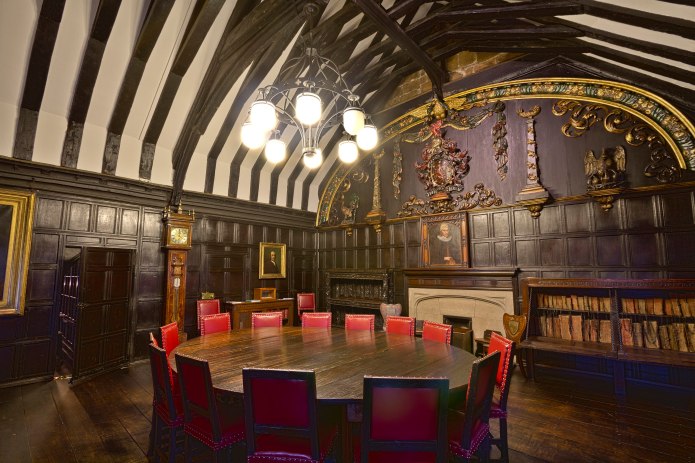
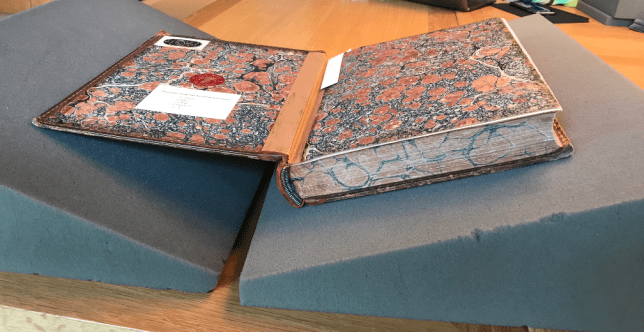
[ Photo of Chetham’s Library reading room by Michael D Beckwith used under CC-BY license. Photo of archival book by Patricia Matthew, used by permission. ]
 trianglesci.org
