Scholarly Communications and the latent scholar

In a couple of months, a group of creative scholars, librarians, publishers, artists, and technologists will come together in Chapel Hill for four days for the first Scholarly Communication Institute to be held in the Research Triangle area of North Carolina, after a decade of SCI being held at the University of Virginia.

One of the issues we’ll be grappling with is how to connect the work of scholars with broader publics – not just in one direction (experts sharing what they know with other audiences) but also inviting and encouraging engagement of people from all walks of life in the creation and synthesis and understanding of useful knowledge together.

Visualization of Twitter traffic on a map

In an essay titled “Face the People and Speak” in Boom: A Journal of California last winter, Abby Smith Rumsey (convener and director of the former iteration of SCI at Virginia) wrote about her vision for a changing scholarly communication landscape:

In this world of proliferating arenas of expertise and specialization, we accept that we are, each and every one of us, “the general public” in all things except our own particular area of knowledge or skill. To the mycologist, a microbiologist is a layman, and to the expert on Leonardo da Vinci, the Nobelist in economics is at best an amateur in matters art historical. But, collectively, we advance knowledge and attend to the responsible use of that knowledge.

This year’s theme at the Triangle SCI is Scholarship and the Crowd, and participants will work on envisioning and building models for fostering and sustaining an ecosystem that is more catholic in its scope than what we usually think of when we hear the term “scholarly communication”.

It’s not just about peer reviewed journals, specialist conferences, and experts talking with other experts in narrowly defined disciplines. There is a global community of latent scholars – readers and writers and learners and thinkers; curators, data collectors, and people who are creating rich data sets of the human experience simply by leaving traces of their daily activities in the online spaces so many of us now frequent.

How do we help activate this richness, understand its opportunities, limitations, and constraints, and begin to develop norms to ensure that the benefits accrete into a commons shared by all, and don’t just accrue to an already privileged elite?

Rumsey writes:

It goes almost without saying that we shall have to find a new term for the work ahead, for “scholarly communication” fails to connote either the audiences for or the intentions behind this communication. I have been using the term “expert knowledge” in lieu of “scholarship” to acknowledge that information vital to our well-being is generated by many who are not traditionally considered scholars and that what is of greatest value is the knowledge that such experts create from raw information and data. Whatever term we embrace in the end, what matters is to focus equally on those who create and those who use knowledge. … The challenges and opportunities we will face in the coming decades will demand … humility, concern, and commitment to engage in translating expertise for multiple audiences and attending to the consequences of using knowledge responsibly.

Stay tuned. As the SCI transitions to the Triangle a new group is taking up this challenge. Together we’ll work to shape this broader meaning of “scholarly communication” and to build models that demonstrate it in practice.
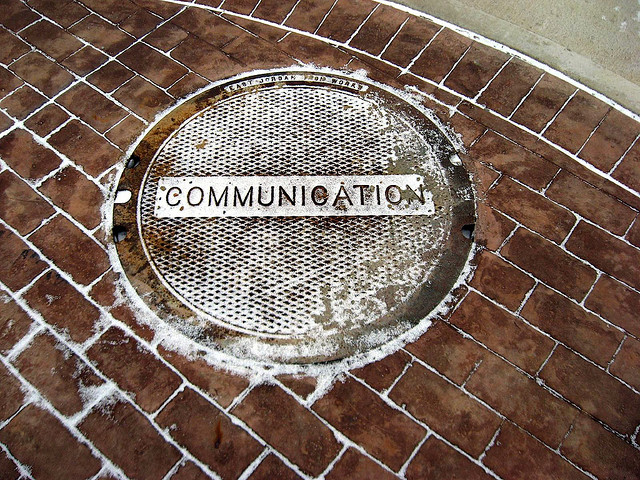
Photo of manhole cover with Communication written on it

[ Image credits: Communication by elycefeliz – https://www.flickr.com/photos/elycefeliz/3224486233 and World travel and communications recorded on Twitter by Eric Fischer – https://www.flickr.com/photos/walkingsf/6635655755 ]
Crowd-sourced Curation and Publication of Special Collections Materials

This is the last in a series of posts about the teams who will be attending the Institute in November, and their projects. This was submitted by Josh Sosin.

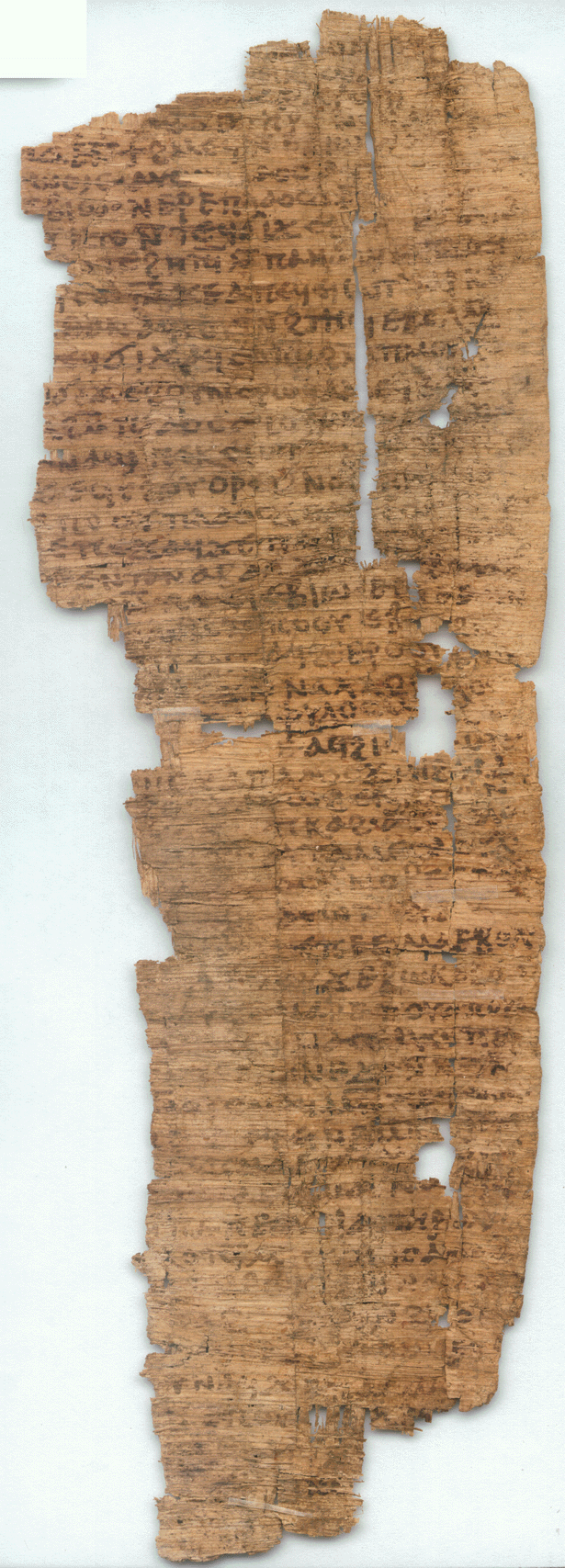
Image of papyrus fragmentLet’s a imagine a student has been working on his Coptic, getting good, looking for a short research project. He discovers that the Rubinstein Library at Duke owns a fragment of I Kingdoms in Sahidic, sits down with the original in the reading room, takes careful notes on its physical and palaeographic features, transcribes the text and collates it against the textual tradition, and leaves at closing time. Later, he discovers that the fragment is our earliest witness to Sahidic I Kingdoms, pre-dating the next oldest witness by half a millennium! What’s more, it shows remarkably little difference from the later text, suggesting a very stable tradition and transmission, entirely out of keeping with scholarly consensus. He writes it up: A. Butts, “P.Duk.inv. 797 (U) – I Kingdoms 14:24-50 in Sahidic,” Le Muséon 118 (2005) 7-20. The discovery is modest, but important. The discipline re-factors what it thinks it knows about I Kingdoms in the light of the new find. Scholars re-group.

But, as typically happens, the patron took notes offline, transcribed and collated the text offline, dated the text on the basis of palaeographic comparanda offline, and published his findings offline. The scholarly workflow that generated the data, produced the findings, and communicated both to the wider community does not touch the library until it receives the journal in which the findings are published; even then, the enhanced information may not effect local intellectual control of the object. This is a missed opportunity, and also the historical pattern: patrons have entered special collections libraries, transcribed, translated, contextualized, and annotated materials, and then walked away knowing in some cases more about the materials than the libraries themselves do. But thanks to a wide variety of crowd-sourcing tools and practices, Libraries are now in a position to support more of that scholarly workflow, bringing more of the results back into the curatorial fold and sharing them with a wider audience than most specialized scholarly publications tend to target.

This SCI group brings together a diverse team of librarians, digital humanisits, faculty, and programmers, to ask what it would take to:

  • pilot an instance of FromThePage, a free, open-source, lightweight transcription, translation, and annotation tool
  • develop undergraduate and graduate classes that focus on scholarly ‘publication’ of special collections materials—including development of workflows to support adding surrogates of original documents digitized in the field (by students and scholars), for scholarly curation by students, scholars, and other partons
  • publish textual content of same in an open, online, free, Duke University Libraries branded venue
  • integrate content with Duke University Libraries digital exhibits workflows, with a view to creating educational mechanisms and vehicles for translating complicated disciplinary materials to a mass audience
  • erect workflows that allows libraries to pull crowd-generated knowledge back into local repositories, catalog records, finding aids etc.

In other words, we mean to ask what it will take to allow future patrons to transcribe, translate, annotate, and ‘pre-publish’ special collections materials in real time, on a Duke-hosted platform; to open results to peer-review; to feed enhancements back into local library controls; to allow others in turn to annotate, emend, and improve these findings; to feed the cumulative results into a sustainable repository of Duke University Libraries digital exhibit materials; and to grow and sustain this entire scholarly eco-system via locally hosted environment that helps transform the owning institution from data host (here are some materials) to knowledge cultivator (here is a place in which our ever-growing, ever-changing knowledge about these materials is made), to become the technical and intellectual hub for scholarly communication around its precious sources.

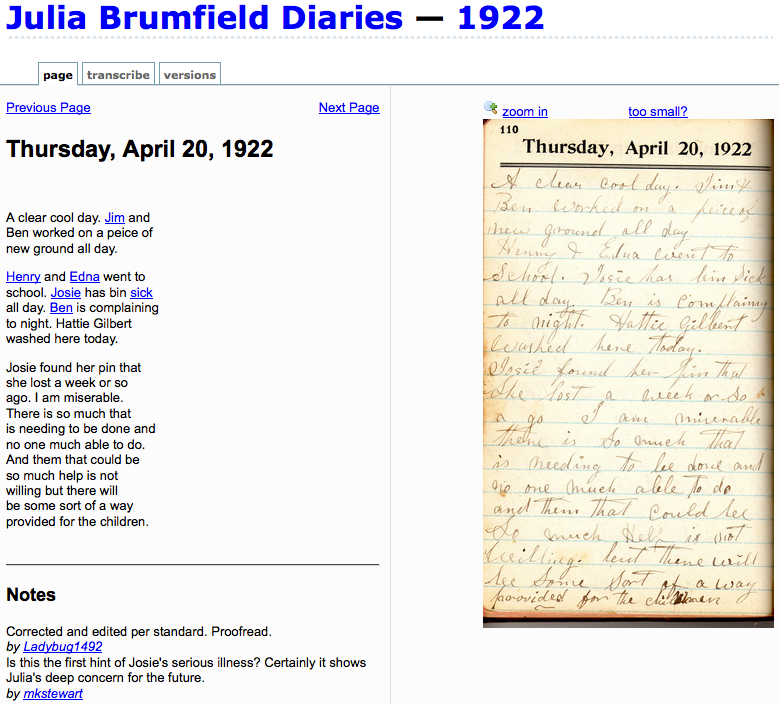
Screen shot of Brumfield diary in FTP system


The members of the group are:

  • Ryan Baumann, Duke Collaboratory for Classical Computing; has been prototyping FromThePage amateur transcription tooling for use cases like the one proposed here; longtime developer of papyri.info, which is a multi-author transcription and editing tool for ancient papyrological texts.
  • Meg Brown, E. Rhodes and Leona B. Carpenter Foundation Exhibits Librarian, Duke University Libraries; the exhibitions program, physical spaces often with a virtual counterpart, includes library created content, but increasingly more faculty and student curated exhibitions that showcase library materials AND/OR University scholarship. The exhibits program educates students and faculty about how to tell their scholarly story to a mass audience.
  • Hugh Cayless, Duke Collaboratory for Classical Computing; has been prototyping FromThePage amateur transcription tooling for use cases like the one proposed here; longtime developer of papyri.info, which is a multi-author transcription and editing tool for ancient papyrological texts.
  • Noah Huffman, Archivist for Metadata and Encoding, Rubenstein Library; one of the more complicated design considerations will be crowd-sourcing of metadata generation and feeding such, which are inherently more prone to conflict than transcription data are, back into local materials.
  • Liz Milewicz, Head, Digital Scholarship Services, Duke University Libraries.
  • Josh Sosin, Duke Collaboratory for Classical Computing; Associate Professor of Classical Studies and History, Co-Director of the DDbDP, Associate editor of Greek, Roman, and Byzantine Studies; an epigraphist and papyrologist interested in the intersection of ancient law, religion, and the economy.

Publishing Makerspace

This is the fourth in a series of posts about the teams who will be attending the Institute in November, and their projects. This was submitted by Sylvia Miller.

The Publishing Makerspace group is a cross-functional working group of 6 people who bring a range of skills and experiences to a creative discussion about what publishing is and what it can become.  We were inspired by the makerspaces that engineering departments, and increasingly libraries, are hosting in which participants use existing products, tools, and skills in creative new ways.  As they dismantle electronics and bend circuits, or use 3D printers to create an object from a drawing, we are interested in how we might bend our various sets of skills and improve existing tools to redefine publishing in a more comprehensive and less segmented way than it is often defined today by many publishers, librarians, and scholars.  In this way we hope to respond to new forms of scholarship and perhaps devise useful and exciting new forms of publishing.

Makerspace visualization

Chicago Public Library makerspace – visualization

To move from the metaphorical to the practical plane, we are starting out by discussing the following ideas:

1.  Multimodal scholarship would benefit from being produced in a more integrated way, so that publishers, libraries, humanities centers, and IT services don’t have to expend so much costly time and effort in the tedious translation of incompatible coding.  We are interested in seeing books and articles included in a broad definition of multimodal scholarship.  In beginning to envision an integrated process, we note the gaps in existing tools and very quickly wade into the weeds of authoring tools and publishing platforms.  However, our goal is to do just that, rather than invent yet another tool or platform.

2.  The makerspace that we envision is not only the liminal space where our small group will wrangle with publishing processes; it is also a potential online space where scholars can collaborate and share on an ongoing basis.  We imagine that this makerspace will knit together a number of existing tools in a new way.  A few of our group members are already working on such a makerspace intended to serve the partners in an inter-institutional scholarly collaboration funded by the Mellon Foundation.

We are delighted that our group was chosen by the Scholarly Communications Institute for a workshop next November.  In fact, we are so enthusiastic that we have already started a listserv, a Twitter hashtag (#PublishingMakers), a GoogleDocs area, and a GitHub repository, although we have not had a chance to do much with them yet!  We also plan to start a shared zotero bibliography.  Our first official meeting was a GitHub tutorial given by group member John Martin.  We will report on that in a separate post.

The members of the group are:

  • Courtney Berger, Senior Editor & Editorial Department Manager, Duke University Press
  • Marjorie Fowler, Digital Asset Coordinator, UNC Press
  • John D. Martin III, Doctoral Fellow, School of Information and Library Science, University of North Carolina at Chapel Hill
  • Sylvia K. Miller, Senior Program Manager, Consortium of Humanities Centers and Institutes
  • David Phillips, Associate Professor of Interdisciplinary Humanities, Innovation, Creativity, and Entrepreneurship (ICE), and Women’s, Gender and Sexuality Studies at Wake Forest University
  • Chelcie Rowell, Digital Initiatives Librarian, Z. Smith Reynolds Library, Wake Forest University
CPL Maker Lab

CPL Maker Lab

[ Images from Makerspace Workshop ALA Chicago Public Library by Katie Day ]